

You might not realize it, but right now, as you read this, there is likely a synthetic substance coursing through your veins that does not belong in nature.
It is invisible. It is tasteless. And it is virtually indestructible.
These substances are known as PFAS (per- and polyfluoroalkyl substances), or more ominously, “Forever Chemicals.” They are the magic ingredients that make your frying pan non-stick, your rain jacket waterproof, and your burger wrapper grease-resistant.
For decades, we were told these products were miracles of modern convenience. But a massive leak of internal documents has revealed a darker reality. A recent investigation coordinated by Die Welt and analyzed by the Spanish outlet Datadista exposes a scandal that rivals the tobacco industry’s cover-ups.
The investigation, involving over 14,000 declassified documents, proves a chilling fact: The chemical giants didn’t just accidentally poison the planet—they knew they were doing it for decades, and they spent millions to keep it a secret.
Here is the story of a 70-year-long deception.
The Indestructible Bond
To understand the scandal, you first need to understand the chemistry. Developed in the 1940s, PFAS are defined by the carbon-fluorine bond, one of the strongest in organic chemistry. This bond makes materials repel water, oil, and heat.
However, this strength is also a curse. Because the bond is so strong, nature cannot break it down. PFAS do not decompose. Instead, they migrate—from factories into the water, into the soil, into crops, and finally, into us. Once inside the human body, they accumulate, binding to proteins in the blood.
Today, science links PFAS exposure to kidney and testicular cancer, thyroid disease, high cholesterol, ulcerative colitis, and birth defects.
But here is the twist: The manufacturers didn’t need modern scientists to tell them this.
The Secret Timeline: “Strictly Avoid Contact”
The documents analyzed by the Forever Pollution Project create a timeline of negligence that is difficult to comprehend. While marketing “safe” kitchenware to housewives in the 1960s, internal scientists at DuPont and 3M were already sounding the alarm.
1961: The Enlarged Livers
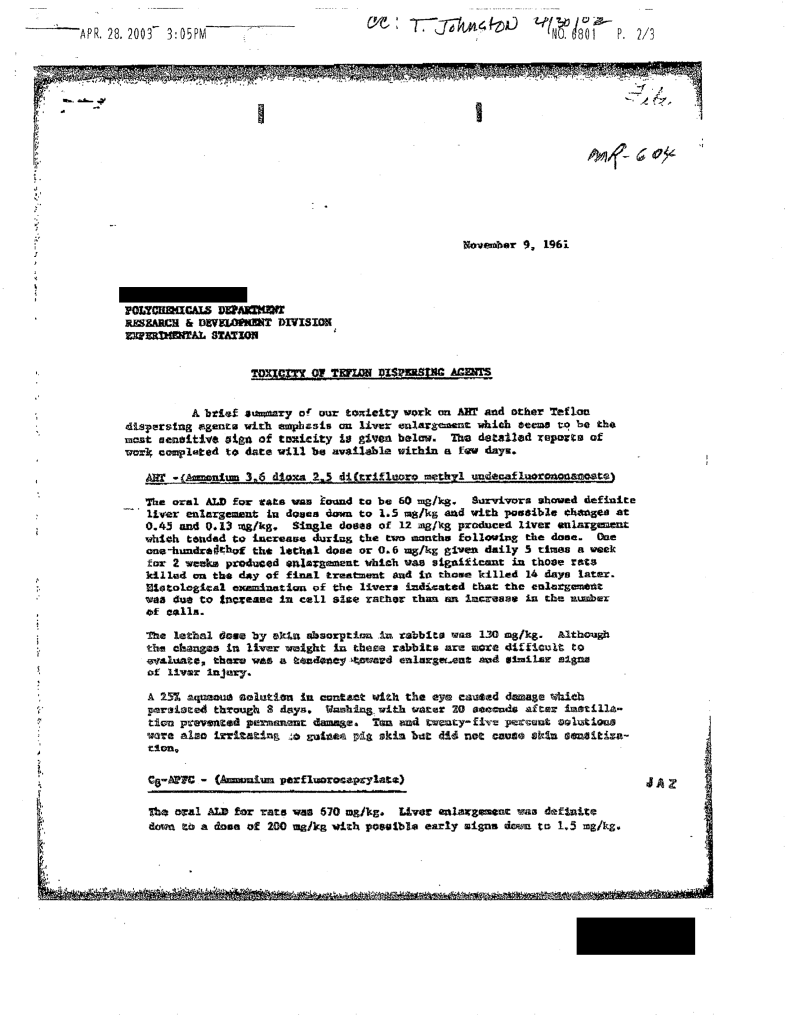
The “smoking gun” appears as early as November 1961. An internal DuPont document titled “Toxicity of Teflon Dispersing Agents” detailed a study where rats and rabbits were exposed to PFAS chemicals (specifically C8).
Even with skin contact alone, the animals suffered liver enlargement. The document’s conclusion was stark and terrifyingly clear: “Handling should be with the utmost care. Contact with the skin should be strictly avoided.”
Did they stop production? No. Did they warn the workers handling these chemicals daily? No. The files were marked classified, and business continued as usual.
1963: “Moderate Toxicity”
Two years later, in a 1963 internal technical manual, 3M—the creator of Scotchgard and a primary supplier of PFAS—admitted that these fluorocarbon surfactants possessed toxicity ranging from “slight” to “moderate.”
In the chemical industry, “moderate toxicity” is a significant red flag. Yet, publicly, the stance remained that these compounds were inert and biologically harmless.

1965: The “Polymer Fume Fever”
By the mid-60s, the effects were moving from animals to humans. Workers in Teflon production areas began falling ill with a mysterious condition characterized by fever, chills, and difficulty breathing.
It was dubbed “Polymer Fume Fever.”
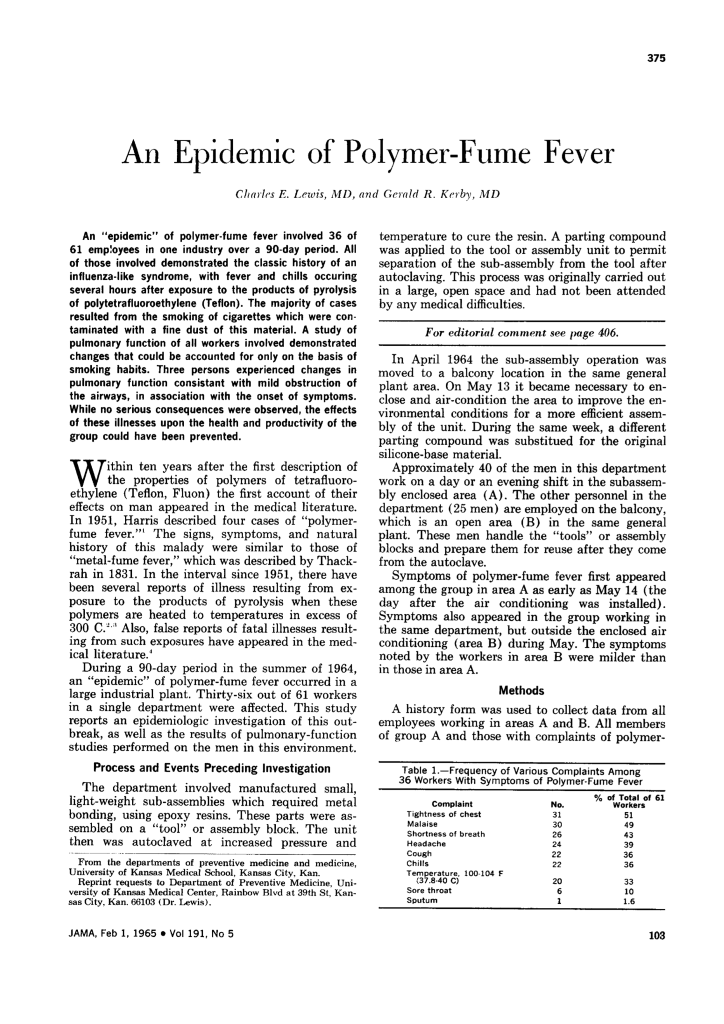
Internal investigations revealed the cause: workers were smoking cigarettes in the facility. Fine PFAS dust in the air would settle on their cigarettes. When lit, the heat decomposed the chemicals, and the workers inhaled the toxic fumes.
A 1965 report noted that out of 61 employees, 36 had experienced these symptoms. Rather than fixing the ventilation or warning the public about the dangers of heating Teflon, the company simply kept the findings internal.
1966: “Time and Money”
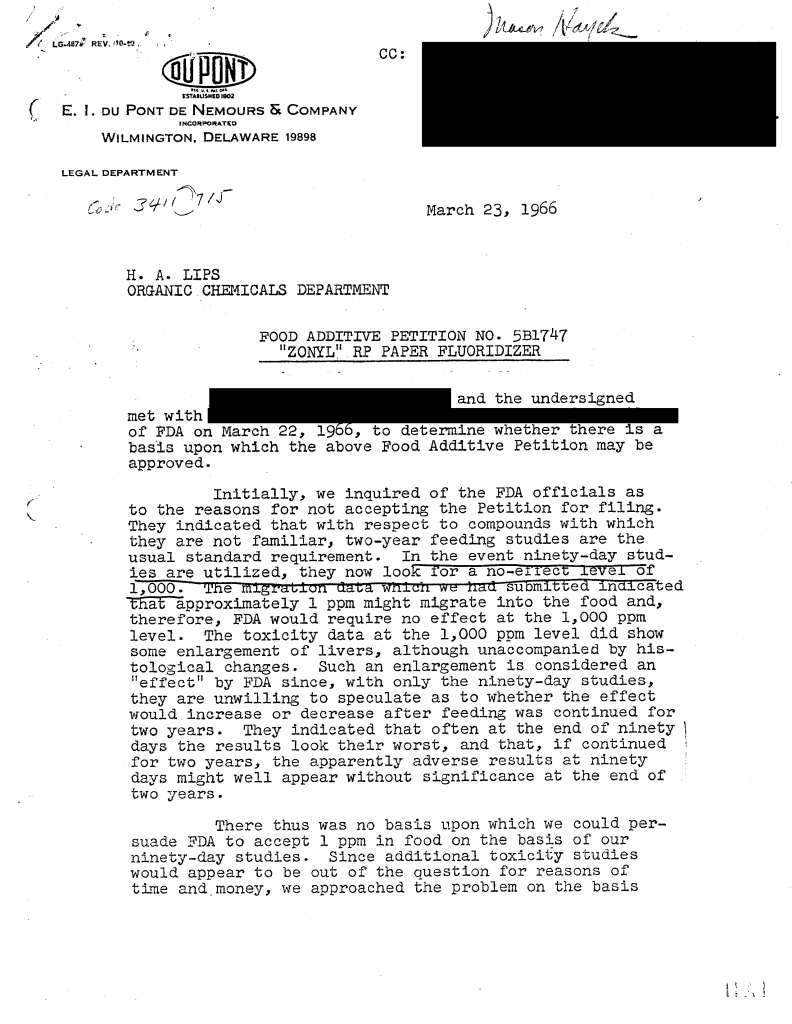
Perhaps the most cynical revelation comes from a 1966 strategy regarding the FDA. DuPont wanted approval to use Zonyl (a PFAS compound) in food packaging—wrappers that would touch the food you eat.
The FDA required a two-year study on health impacts. DuPont’s internal memo is damning. It states that “because of time and money,” they would not conduct the long-term toxicity study.
Instead of proving safety, they negotiated a “permissible level” with the FDA based on limited data. They argued for a threshold of 3 parts per million, knowing full well that even small amounts accumulate in the body over time.
1981: The Missing Eyes
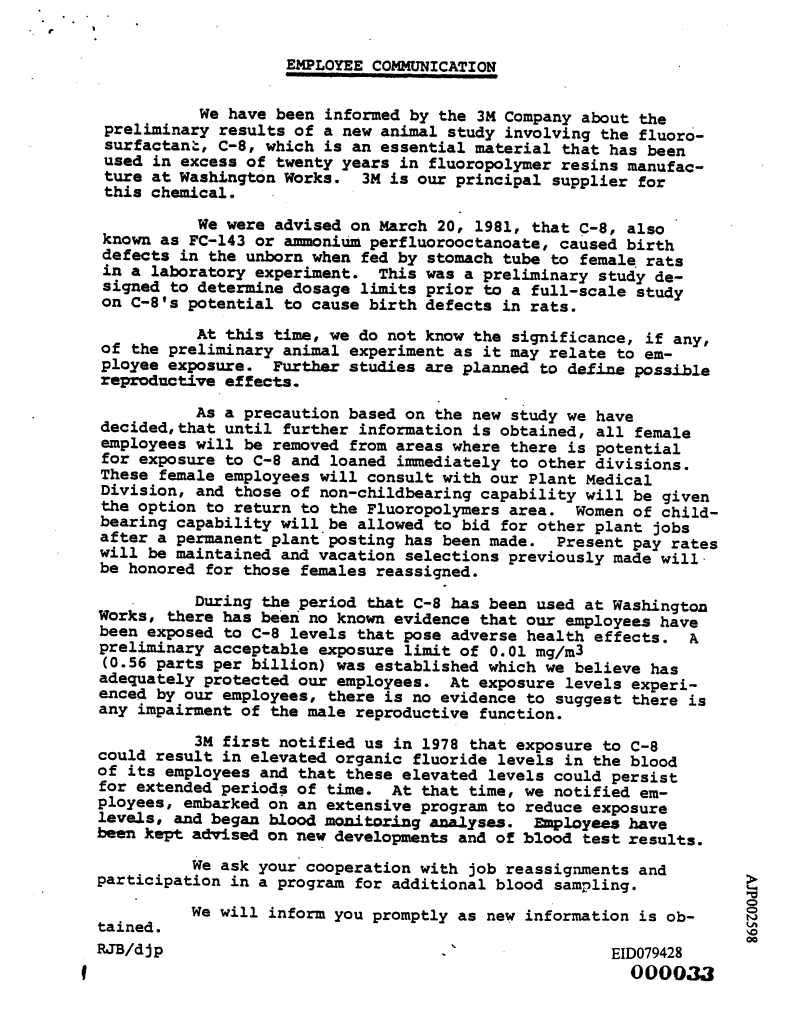
The deception turned tragic in the 1980s. After a 3M study showed that PFAS caused birth defects in the eyes of rat fetuses, DuPont quietly tracked pregnant employees at their West Virginia plant.
They found seven pregnant women who had been exposed to C8. Two of them gave birth to babies with eye defects and nostril deformities.
This is a statistical anomaly so high it should have shut down the plant immediately. Instead, DuPont removed the women from the production line, buried the data, and did not report it to the EPA. They continued to tell the world that C8 had “no known toxic effects.”
The “Whack-a-Mole” Strategy
For decades, the strategy was simple: Deny, Delay, and Distract.
When the dangers of specific “long-chain” PFAS (like PFOA and PFOS) became undeniable in the early 2000s, the industry didn’t stop. They simply switched to “short-chain” replacements (like GenX). They marketed these as the safe alternative.
We now know this was a lie. These shorter molecules are just as persistent and arguably harder to filter out of water supplies.
It is a game of regulatory Whack-a-Mole. There are over 10,000 distinct PFAS compounds. If regulators ban one, the industry tweaks a molecule and releases a “new” one, resetting the clock on safety studies.
The Forever Lobby: The Battle for a Ban
Today, the scale of contamination is global. PFAS have been found in rainwater in Tibet, in the ice of Antarctica, and in the blood of 99% of Americans and Europeans.
Faced with this catastrophe, five European nations (Germany, the Netherlands, Norway, Sweden, and Denmark) have proposed a historic Universal PFAS Restriction (uPFAS). This would ban the entire class of chemicals—all 10,000 of them—at once.
The chemical industry is terrified.
The investigation reveals a massive counter-offensive known as “The Forever Lobbying Project.” Chemical giants, joined by the plastics, electronics, and even pharmaceutical industries, are pouring millions into Brussels to kill the ban.
Their arguments are familiar: “The economy will collapse,” “We can’t make microchips without it,” “Scientific certainty is missing.” They are fighting to exempt as many categories as possible, hoping to dilute the ban until it is meaningless.
Conclusion: The Cost of Silence
The Datadista report and the files from the Forever Pollution Project are not just history lessons; they are a warning.
For 70 years, corporate entities prioritized quarterly profits over the biological integrity of life on Earth. They treated the human bloodstream as a chemical dumping ground, relying on the fact that the effects—cancer, organ damage, immune system disruption—take years to manifest.
The documents are now out in the open. The timeline of deception is clear. The question remains: Will we allow them to delay the ban for another decade, or will we finally say that enough is enough?
This article is based on the investigation “The Forever Pollution Project” and reporting by Datadista. To explore the maps of contamination and read the original documents, visit ForeverPollution.eu.