
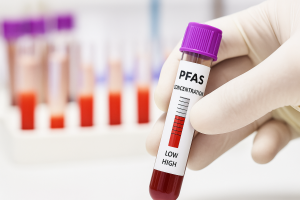

BRUSSELS — All 24 top European Union politicians from 19 countries who underwent blood testing have tested positive for toxic PFAS “forever chemicals,” with half showing contamination levels that exceed safe thresholds where adverse health effects cannot be ruled out.
The groundbreaking initiative, led by the Danish Ministry of Environment and Gender Equality together with the European Environmental Bureau (EEB) and ChemSec AllEvents, reveals a stark reality: chemical pollution spares no one, regardless of status or position.
Among those tested were three Vice-Presidents of the European Commission, the Environment Commissioner, the head of the European Environment Agency, and six Members of the European Parliament from various European countries Ma Santé. Between three and eight PFAS chemicals out of the 13 tested were detected in all officials’ blood, with PFOS showing the highest concentrations of up to 17.19 ng/ml.
Danish Environment Minister Magnus Heunicke described his test results as revealing a “frightening reality,” stating he tested positive for four substances, three of which can harm unborn children, act as endocrine disruptors, cause liver damage, and are suspected of being carcinogenic.
The Health Impact
PFAS chemicals are linked to severe health issues including cancer, infertility, birth defects, and immune system disruptions Actionjusticeclimatlyon. All individuals tested have total PFAS exposure above 2 ng/ml, the level beyond which specific medical follow-up is recommended by the US National Academies.
Alarmingly, six of the detected PFAS are already regulated in Europe under either the EU POPs Regulation or the REACH Regulation, underscoring their lasting impact and continued threat despite existing bans.
Pollution Hotspots and Legal Battles
Major PFAS pollution scandals with exposure around 100 times higher than average have been documented across the EU, including cases in the Veneto region of Italy, the “chemical valley” of France near Lyon, the Netherlands, and Flanders and Wallonia in Belgium.
Victims have initiated legal battles, exemplified by a recent ruling in Ronneby, Sweden, declaring that residents exposed to high PFAS levels through drinking water can seek compensation for personal injury from the responsible company.
Hope Through Regulation
Despite the grim findings, there are signs that regulatory action works. Leena Ylä-Mononen, Executive Director of the European Environment Agency, who had previously tested her blood, showed a decline in PFAS levels, reflecting trends observed among the European population for restricted PFAS.
“These results prove two things: PFAS contamination spares no one, and regulation works,” says Anne-Sofie Bäckar, Executive Director at ChemSec.
The Economic and Policy Challenge
Cleaning up existing contamination could cost the EU up to €2 trillion over the next 20 years, not including the additional €52-84 billion in yearly health-related costs. However, new and replacement PFAS continue to accumulate in people’s blood, with concentrations of some compounds rising sharply, underscoring the need for broad, group-based restrictions to prevent regrettable substitutions.
In 2020, the European Commission acknowledged the PFAS crisis in its “Chemicals Strategy for Sustainability,” which outlines phasing out PFAS use in the EU unless essential. However, industry and political pressures have stalled the much-needed reform of the outdated REACH regulation.
Under the Toxic Free Future campaign led by the EEB with participation from nine national non-profit organizations, 16 additional politicians from the Czech Republic, Spain, and Belgium have also undergone PFAS blood testing, further highlighting the pervasive nature of this silent health crisis.