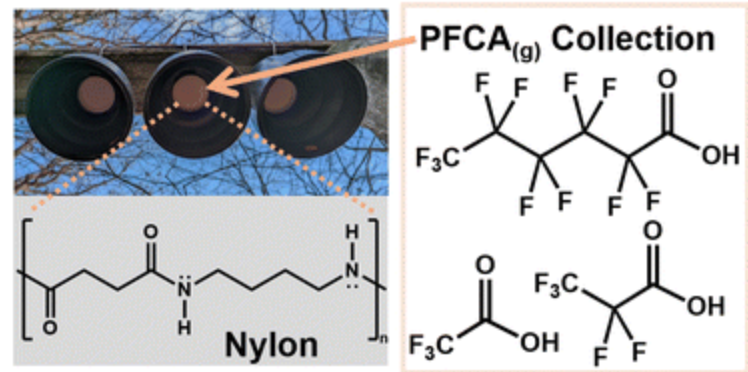

Toronto, Canada, September 1, 2025 — Scientists at York University and Environment and Climate Change Canada have developed a groundbreaking nylon-based passive air sampler capable of detecting ultra-trace levels of perfluoroalkyl carboxylic acids (PFCAs) in the atmosphere, offering a low-cost solution for monitoring “forever chemicals” in ambient air.
The research, published in Environmental Science: Processes & Impacts on September 1, 2025, represents a significant advancement in understanding how PFAS form, transport, and persist in the atmosphere.
Revolutionary Detection Sensitivity
The novel passive air samplers (PAS) are specifically designed to capture gaseous PFCAs with unprecedented sensitivity. For trifluoroacetic acid (TFA), the shortest-chain PFCA, the method achieves detection limits at parts per quadrillion by volume (ppqv; 10⁻¹⁵ mol mol⁻¹) for a sampling period of just one week.
Led by researchers Eric Vanhauwaert, Trevor C. VandenBoer, and colleagues, the team established sampling rates through extensive quality assurance tests, including controlled chamber experiments. The sampling rate for gaseous TFA was determined experimentally, while rates for C3–C6 PFCA homologues were derived using diffusion theories.
Year-Long Field Study Reveals Key Trends
Over approximately one year, the research team deployed samplers at three strategically selected Canadian sites representing different environmental contexts:
- Toronto, Ontario (urban, two locations)
- Tadoussac, Quebec (rural, downwind of urban areas)
- Saturna Island, British Columbia (remote marine)
Key Findings:
All PFCA homologues from C2–C6 were detected above method detection limits, with several notable patterns:
- Chain Length Effect: Abundance decreased with increasing carbon chain length, with TFA substantially dominating at 11-200 ppqv, while other PFCAs ranged from 0.2-26.4 ppqv.
- Urban-to-Remote Gradient: Gaseous TFA concentrations followed a clear spatial trend—highest in urban Toronto, moderate in rural Tadoussac, and lowest at remote Saturna Island. This pattern aligns with predicted atmospheric formation from precursors.
- Seasonal Variation: In Toronto and Tadoussac, TFA concentrations were significantly higher in summer and lower in winter. “This seasonal trend for gaseous TFA has previously been observed in Toronto and elsewhere,” the study noted. “Seasonal differences for TFA have been attributed to increased photochemical activity in summer, as well as increased emissions of precursors.”
- Link to HFO-1234yf: The findings are consistent with TFA formation from HFO-1234yf, a hydrofluoroolefin (HFO) widely used in mobile air-conditioning systems as a replacement for older refrigerants. The seasonal and spatial patterns support models describing atmospheric TFA formation from such precursors.
Atmospheric Formation Pathway
Atmospheric oxidation is increasingly recognized as a significant source of persistent PFCAs. Volatile PFAS precursors—including HFOs used in refrigeration, firefighting foams, and other industrial applications—undergo photochemical degradation in the atmosphere to form PFCAs like TFA.
Unlike traditional laboratory analysis requiring expensive mass spectrometry equipment and lengthy processing times, passive samplers offer a cost-effective alternative for long-term monitoring programs, particularly valuable for remote or resource-limited locations.
Advantages of Passive Sampling
The nylon-based PAS technology offers several key benefits:
- Selective collection of atmospheric acids
- Ultra-trace sensitivity at ppqv levels
- Low-cost deployment suitable for widespread monitoring networks
- No power or active pumping required
- Field-ready for diverse environmental conditions
“This new PFCA-specific passive air sampling method represents a promising new option for the study of PFCA formation, transport, and fate in the atmosphere,” the researchers concluded.
Public Health and Environmental Implications
PFAS compounds, including PFCAs, have raised significant health and environmental concerns due to their:
- Extreme environmental persistence
- Bioaccumulation potential
- Links to various health effects including immune suppression, thyroid disease, and cancer
- Global distribution via atmospheric transport
The ability to monitor gaseous PFCAs at ultra-trace levels will enable researchers and regulators to better understand atmospheric PFAS chemistry, track pollution sources, and assess human and environmental exposure pathways.
Future Applications
The research team envisions this methodology being adopted for:
- Long-term atmospheric monitoring networks
- Source apportionment studies
- Assessing the impact of regulatory measures
- Remote and Arctic region monitoring
- Tracking temporal trends in PFAS atmospheric loading
As countries implement stricter PFAS regulations and phase out certain fluorinated compounds, this sampling technology will prove crucial for verifying the effectiveness of these measures and identifying emerging atmospheric PFAS sources.
Research Publication
The study, “Selective ultra-trace atmospheric passive sampling of gaseous perfluoroalkyl carboxylic acids,” was published in Environmental Science: Processes & Impacts, 2025, Volume 27, pages 2785-2797 (DOI: 10.1039/D5EM00297D).
Source: Royal Society of Chemistry, Environmental Science: Processes & Impacts (pubs.rsc.org)