
Introduction
Trifluoroacetic acid (TFA) is an ultra-short-chain perfluoroalkyl substance (PFAS) that has become a growing environmental concern. As a degradation product of hydrofluorocarbons (HFCs) and hydrofluoroolefins (HFOs)—replacements for ozone-depleting substances under the Montreal Protocol—TFA is accumulating in water bodies worldwide. While the United Nations Environment Programme (UNEP) has assessed TFA’s environmental impact in its regular reports, I believe their calculation methodology contains a critical error that significantly underestimates future ocean concentrations and, more alarmingly, masks the severe localized pollution risks posed by rapidly-degrading HFOs.
The Core Issue: Ignoring Ocean Stratification
The fundamental problem lies in how UNEP calculated future TFA concentrations in the ocean. In their 2022 Assessment Report, they used the entire ocean volume (1.36 × 10⁹ km³) as the basis for dilution calculations. This approach assumes TFA will be evenly distributed throughout all ocean depths—from surface waters to the deep sea. However, this assumption contradicts basic oceanographic principles.
Ocean Stratification Theory
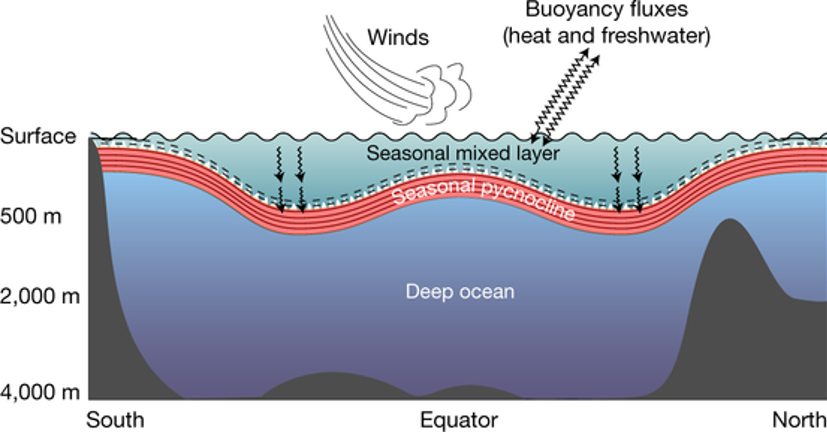
According to physical oceanography, the ocean is not a homogeneous body of water. Except in high-latitude regions, oceans exhibit a stable layered structure divided by density gradients (pycnoclines) into distinct zones:
- Surface mixed layer (typically 50-200 meters deep)
- Thermocline/pycnocline (transition zone)
- Deep ocean layer
The density stratification creates a natural “barrier” between layers. The thermohaline circulation—the global ocean conveyor belt—takes thousands of years to achieve complete equilibrium. Studies indicate:
- Waters deeper than 1,000 meters have equilibration times of approximately 200 years
- At 3,000-meter depths, this extends to 1,500 years
- Complete deep-ocean salinity and temperature equilibration requires 3,900-4,500 years
Implications for TFA Distribution
TFA entering the ocean through precipitation, river runoff, and atmospheric deposition will primarily affect only the surface mixed layer in the short term (within centuries). The vertical mixing time within the mixed layer is only hours to days, meaning TFA will rapidly become well-mixed within this surface zone but will not penetrate significantly into deeper waters on timescales relevant to human society.
Whether from human activities or natural processes like rainfall, wind, and climate factors, impacts occur predominantly in the surface mixed layer, not the deep ocean.
Comparing Calculation Methods
Let me present three different approaches to calculating future ocean TFA concentrations:
Table 1: Comparison of TFA Calculation Methodologies and Results
| Source | Calculation Basis | 2050 Concentration (ng L⁻¹) | 2100 Concentration (ng L⁻¹) | Increase from 2020 |
|---|---|---|---|---|
| UNEP 2022 Report | Total ocean volume (1.36 × 10⁹ km³) | 244-246 | 266-284 | +22.0% to +37.5% |
| Hanson et al. 2024 | Epipelagic zone only (top 200m) | 736 | 1,058 | +268% to +429% |
| My Recalculation | Surface mixed layer with ocean stratification | 650-823 | 4,120-4,286 | +225% to +2,043% |
Note: All concentrations expressed as sodium salt equivalents. 2020 baseline assumed as 200 ng L⁻¹
UNEP’s Original Calculation (2022)
The UNEP Environmental Effects Assessment Panel projected that TFA from HFC-134a and HFO-1234yf degradation would increase ocean concentrations from a nominal 200 ng L⁻¹ in 2020 to:
- 2050: 244-246 ng L⁻¹ (22-23% increase)
- 2100: 266-284 ng L⁻¹ (33-42% increase)
This calculation assumed even distribution across the entire ocean volume of 1.36 × 10⁹ km³.
Hanson’s Corrected Approach (2024)
Recognizing the stratification issue, Hanson et al. (one of the UNEP report authors) published a correction in 2024. They recalculated concentrations assuming TFA uptake limited to the epipelagic zone (top 200 meters of ocean where sunlight penetrates):
- 2050: 736 ng L⁻¹
- 2100: 1,058 ng L⁻¹
This represents a 268-429% increase from 2020 levels—dramatically different from UNEP’s original estimates. Hanson subtly acknowledged that UNEP’s calculation was incorrect by noting that if uptake is “limited to the epipelagic zone” rather than “distributed throughout the ocean,” concentrations would be several times higher.
My Enhanced Calculation: Ocean-Specific Analysis
Taking this approach further, I calculated TFA concentrations for each major ocean basin, accounting for:
- Actual ocean surface areas and volumes
- Initial TFA concentrations varying by ocean (Pacific: 9 ng L⁻¹, Atlantic/Indian: 175 ng L⁻¹)
- Surface mixed layer as the affected volume (representing ~50% of total ocean area depth-averaged to 200m)
- Projected TFA deposition from HFC-134a and HFO-1234yf degradation
Table 2: Projected TFA Concentrations by Ocean Basin
| Ocean | Surface Area (km²) | Area Ratio | 2020 TFA Baseline (ng L⁻¹) | 2050 Projected (ng L⁻¹) | % Increase | 2100 Projected (ng L⁻¹) | % Increase |
|---|---|---|---|---|---|---|---|
| Pacific | 179,680,000 | 49.8% | 9 | 650.7 | +7,130% | 4,120 | +45,700% |
| Atlantic | 93,363,000 | 25.9% | 175 | 823 | +370% | 4,286 | +2,350% |
| Indian | 74,917,000 | 20.8% | 175 | 823 | +370% | 4,286 | +2,350% |
| Global Average | 360,900,000 | 100% | ~130* | 745 | +473% | 4,169 | +3,107% |
*Weighted average based on ocean area distribution (Pacific 91% of volume at baseline concentration 9 ng L⁻¹)
Total TFA Mass Accumulation:
- 2020-2050: 6.95 million tonnes deposited
- 2020-2100: 41.70 million tonnes deposited
The Hidden Danger: “In-Situ” Pollution from Short-Lived HFOs
Beyond the ocean stratification issue, UNEP’s calculation error conceals an even more immediate and dangerous problem: localized TFA pollution hotspots caused by the rapid degradation of fourth-generation HFOs.
The Critical Difference Between HFCs and HFOs
The transition from third-generation HFCs to fourth-generation HFOs represents a dramatic shift in atmospheric behavior:
| Property | HFC-134a (3rd Gen) | HFO-1234yf (4th Gen) | Implications |
|---|---|---|---|
| Atmospheric Lifetime | ~14 years | ~11 days | 460× shorter |
| Global Distribution | Worldwide, uniform | Regional, concentrated | Localized deposition |
| TFA Molar Yield | 7-20% | ~100% | 5-14× more TFA per molecule |
| Time to Degrade | Years to distribute globally | Days before returning locally | “In-situ” pollution |
The “In-Situ” Pollution Mechanism
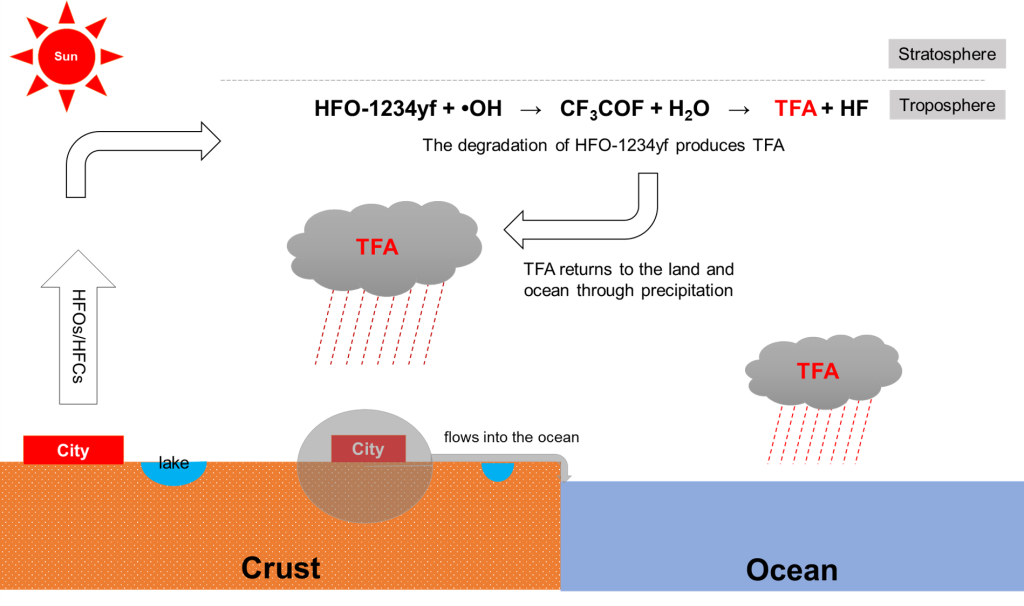
HFO-1234yf’s extremely short atmospheric lifetime of approximately 11-14 days creates a dangerous phenomenon I call “in-situ” or “on-site” pollution:
- Emission: Urban areas release HFO-1234yf from vehicle air conditioning systems
- Rapid Degradation: Within days, UV radiation and OH radicals convert HFO-1234yf to TFA in the troposphere directly above the emission source
- Immediate Return: Before atmospheric circulation can disperse the TFA, local precipitation brings it back to the ground in concentrated pulses
- Accumulation: Repeated cycles create localized TFA accumulation in urban and suburban areas
This is fundamentally different from long-lived HFCs, which had time to disperse globally before degrading, resulting in relatively uniform worldwide TFA deposition at low concentrations.

The Acid Rain Connection
The immediate return of TFA through precipitation creates conditions analogous to acid rain, with several concerning characteristics:
- Concentration Spikes: Individual rainfall events can contain TFA concentrations orders of magnitude higher than average
- Urban Hotspots: Cities with high HFO usage (major metropolitan areas, regions with hot climates requiring extensive air conditioning) become pollution centers
- Unpredictable Patterns: Wind direction, weather systems, and rainfall intensity create highly variable local exposures
- Cumulative Effects: Unlike traditional acid rain (which can be neutralized by soil buffering), TFA accumulates irreversibly
Evidence from Atmospheric Modeling
Studies modeling HFO-1234yf degradation have found:
- Peak deposition rates of several kilograms per km² per year downwind of major emission sources
- Rainwater TFA concentrations reaching several micrograms per liter in urban areas
- 100-fold or greater variations in deposition between urban and remote locations
- Seasonal patterns correlating with UV intensity and OH radical concentrations
In one study from Germany, TFA concentrations in precipitation samples showed:
- Detection frequency > 90% except during winter months
- Maximum concentrations up to 2,120 ng L⁻¹ at urban sites
- 10-fold differences between high and low emission areas within the same country
Unknown Health and Environmental Impacts
The localized concentration spikes pose risks that UNEP’s averaged global calculations completely overlook:
- Aquatic Ecosystems: Lakes, streams, and wetlands in urban areas may experience TFA concentrations far exceeding current toxicity thresholds during rainfall events
- Drinking Water Sources: Surface water intakes near cities could periodically contain elevated TFA levels, with no effective removal by conventional water treatment
- Agricultural Impacts: Crops irrigated with TFA-contaminated water may accumulate the compound, with unknown consequences for food safety
- Chronic Low-Level Exposure: Urban populations may experience continuous low-level TFA exposure through drinking water, food, and air—effects currently unstudied
- Vulnerable Populations: Children, pregnant women, and individuals with compromised health may be at particular risk from repeated exposure spikes
Why UNEP’s Error Is So Dangerous
By calculating only global average concentrations diluted across entire ocean volumes, UNEP’s methodology:
- Masks Regional Hotspots: Fails to identify urban areas where actual concentrations may be 100-1000× higher than global averages
- Ignores Peak Exposures: Averages out concentration spikes that could cause acute effects or contribute to chronic toxicity
- Underestimates Risk: Suggests TFA increases will be gradual and minor when reality may involve sudden, dramatic local increases
- Delays Action: Creates false reassurance that allows continued HFO deployment without adequate monitoring or precautionary measures
- Prevents Preparedness: Cities and water utilities receive no warning to prepare for managing TFA contamination
The Urgent Need for Recognition
This “in-situ” pollution phenomenon represents a paradigm shift in how we must think about atmospheric pollutant transport and deposition. Unlike traditional pollutants or even earlier-generation refrigerants, HFOs create a direct, rapid pathway from urban emission sources to local environmental contamination with minimal atmospheric dilution.
UNEP’s calculation error doesn’t just underestimate future ocean concentrations—it completely obscures the immediate, localized pollution crisis that is already emerging in major cities worldwide.
Why This Matters
The differences between these three approaches are not merely academic. They have significant implications for:
1. Risk Assessment
While current toxicity thresholds suggest TFA poses minimal risk even at elevated concentrations, the rate of increase matters. My calculations show concentrations rising by:
- 40-70× by 2050 (in some ocean basins)
- 300-450× by 2100 (in the Pacific Ocean)
These increases are far more dramatic than UNEP’s modest 22-42% projections.
More critically, localized urban concentrations during precipitation events could temporarily exceed even these projections by additional orders of magnitude, reaching levels where toxicological effects become uncertain and potentially concerning.
2. Regulatory Decisions
Global regulation of TFA and its precursors depends on accurate environmental projections. If policymakers believe TFA concentrations will barely increase (UNEP’s original assessment), they may not prioritize:
- Developing alternatives to current HFOs
- Implementing urban TFA monitoring programs
- Establishing drinking water standards for TFA
- Requiring environmental impact assessments for HFO deployment
The calculation error effectively delays or prevents regulatory action that could mitigate localized pollution risks.
3. Regional Impacts
HFOs have short atmospheric lifetimes (days to weeks) compared to HFCs (years to decades). This means TFA deposition will be highly regionalized near emission sources. Coastal areas downwind from major urban centers using HFO-1234yf in vehicle air conditioning could experience far higher concentrations than open-ocean averages.
Metropolitan areas in warm climates with high air conditioning demand represent primary risk zones that deserve immediate attention and monitoring.
4. Irreversibility
TFA is extremely stable with no known degradation pathways in the environment. Its half-life may be centuries to millennia. Once accumulated, TFA cannot be removed by natural processes. This makes underestimating its accumulation particularly problematic—we cannot “undo” contamination if we realize the problem too late.
Every year of continued HFO emissions without proper assessment adds to an irreversible environmental burden that will persist for generations.
5. Public Health Uncertainty
The most troubling aspect is that we are conducting an uncontrolled experiment on urban populations worldwide. The long-term health effects of chronic, low-level TFA exposure—particularly from localized concentration spikes—remain largely unknown.
Given that TFA can accumulate in plants and potentially enter food chains, the full scope of human exposure pathways has not been adequately characterized.
The Path Forward
Immediate Actions Needed
- Revise UNEP Calculations: Future assessment reports must:
- Explicitly account for ocean stratification
- Provide both whole-ocean and surface-layer concentration projections
- Model regional and local concentration variations
- Assess localized pollution risks from short-lived HFOs
- Emergency Urban Monitoring: Establish systematic TFA monitoring programs in:
- Major metropolitan areas with high HFO usage
- Rainfall and surface waters in urban centers
- Drinking water supplies serving cities
- Urban agricultural areas and food products
- Regional Risk Mapping: Develop geographic risk assessments identifying:
- High-emission urban zones
- Vulnerable water bodies and ecosystems
- Populations at elevated exposure risk
- Critical infrastructure requiring TFA management
- Improved Modeling: Develop coupled atmosphere-hydrological models that account for:
- Regional HFO emission patterns and seasonal variations
- Atmospheric transport and rapid degradation timescales
- Precipitation patterns and localized deposition
- Ocean surface layer dynamics and river discharge
- Urban hydrology and storm water management
- Precautionary Water Treatment: Even without complete toxicological data:
- Implement TFA monitoring in drinking water systems
- Develop and deploy TFA removal technologies for at-risk supplies
- Establish provisional guidelines based on detection capabilities
Long-term Strategy
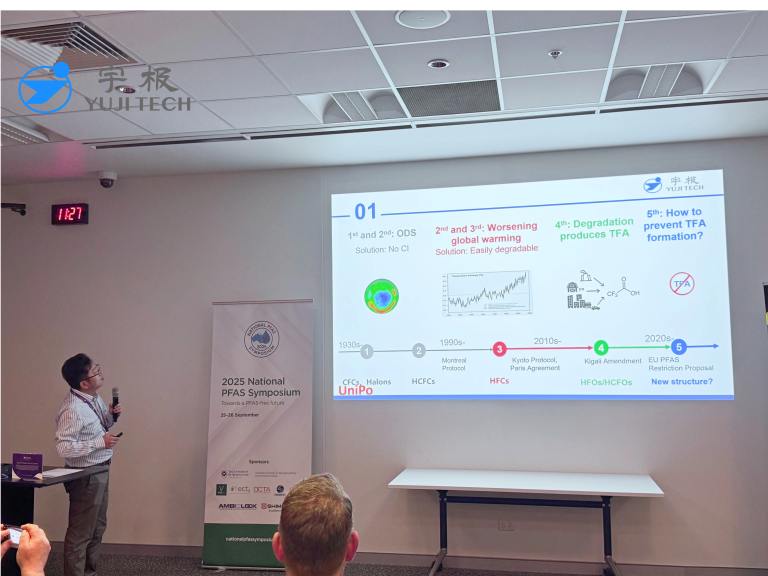
The fundamental solution is to develop fifth-generation ODS (ozone-depleting substance) replacements with three key characteristics:
- Zero ozone depletion potential (ODP)
- Low global warming potential (GWP)
- No TFA formation upon degradation
Major fluorochemical companies are already developing such alternatives. For example:
- Chemours : HFO-1252zc series
- Daikin/AGC : HFO-1132(E), HFO-1123
- Mexichem: HFO-1132a branded as “NO-TFA Producing Refrigerants”
These next-generation compounds avoid molecular structures (like CF₃CF=) that lead to TFA formation.At international conferences, Quanzhou Yuji New Materials Technology Co., Ltd. (China) pioneered the formal definition of the 5th-generation refrigerants, building upon the fourth-generation HFOs’ characteristics of “zero ozone depletion potential (ODP) and low global warming potential (GWP)” by adding a critical third criterion: “no trifluoroacetic acid (TFA) formation upon atmospheric degradation”.
A Call to Action for the Global Community
The scientific community, environmental organizations, and policymakers must recognize that UNEP’s calculation methodology error is not merely a technical mistake—it represents a potentially serious failure to protect public and environmental health.
We urgently need:
- International Scientific Collaboration: Form an independent expert panel to:
- Reassess TFA environmental fate and transport
- Evaluate localized pollution risks
- Establish comprehensive monitoring protocols
- Develop health-protective guidelines
- Transparent Data Sharing: Require HFO manufacturers and users to:
- Report production and emission data publicly
- Fund independent environmental monitoring
- Support epidemiological research in high-exposure areas
- Contribute to remediation costs if harm is demonstrated
- Precautionary Regulation: Implement interim protective measures:
- Phase-out timelines for TFA-producing HFOs
- Incentives for rapid transition to fifth-generation alternatives
- Mandatory TFA monitoring in vulnerable regions
- Reserved authority to ban HFOs if risks materialize
- Public Awareness: Ensure communities understand:
- That HFOs produce persistent TFA pollution
- Where localized hotspots may exist
- How to access monitoring data
- Options for reducing personal exposure
The transition from CFCs → HCFCs → HFCs → HFOs was driven by successive recognition of environmental harms (ozone depletion, then climate change). We cannot afford to discover TFA’s harms only after decades of accumulation have created an irreversible problem.
The time to act is now, while we still have the opportunity to prevent rather than merely respond to environmental contamination.
Conclusion
The UNEP’s use of total ocean volume to calculate TFA concentrations represents a fundamental misunderstanding—whether intentional or not—of ocean dynamics. By ignoring the density stratification that separates the surface mixed layer from deep waters, their methodology dramatically underestimates the concentrations that will accumulate in the ocean zones where:
- Primary biological productivity occurs
- Marine ecosystems are most active
- Most marine life resides
- Water circulates on human-relevant timescales
Hanson et al.’s 2024 correction was a step in the right direction, but even their simplified “top 200m” approach doesn’t fully capture the complexity of ocean basin differences and regional deposition patterns.
My recalculations, accounting for ocean stratification and basin-specific characteristics, suggest that by 2100, surface ocean TFA concentrations could reach 4,000+ ng L⁻¹—more than 20 times higher than UNEP’s original projections. While still below acute toxicity thresholds, this represents a substantial and essentially permanent alteration of ocean chemistry.
More alarmingly, the calculation error completely obscures the “in-situ” pollution crisis emerging in urban areas. The short atmospheric lifetime of HFOs like HFO-1234yf (11-14 days) means TFA is deposited locally before dispersing globally, creating concentration hotspots that may be 100-1000 times higher than global averages in rainfall events over cities.
This localized pollution represents an uncontrolled experiment on urban populations and ecosystems, with unknown health and environmental consequences that could manifest in coming years or decades.
The scientific community and policymakers must acknowledge these calculation errors and take immediate precautionary action. The most responsible path forward is:
- Emergency monitoring of TFA in urban areas and drinking water
- Reassessment of HFO safety based on localized pollution risks
- Accelerated transition to true “zero-TFA” fifth-generation alternatives
The ocean is not an infinite dilution vessel. It’s a structured, layered system where what we put into the surface layer stays in the surface layer for centuries.
Urban air is not a global mixing chamber. It’s a local environment where what we emit today returns to the ground tomorrow.
Our calculations—and our policies—must reflect these realities before irreversible harm occurs.
Reference:
- Sallée, JB., Pellichero, V., Akhoudas, C. et al. Summertime increases in upper-ocean stratification and mixed-layer depth. Nature 591, 592–598 (2021).
- Trifluoroacetic Acid in the Environment Consensus Gaps and Next Steps, Environmental Toxicology and Chemistry—Volume 43, Number 10—pp. 2091–2093, 2024
- Environmental Effectsof Stratospheric Ozone Depletion, UV Radiation,and Interactions with Climate Change, 2022 Assessment Report
- Environmental Issues of Ultra-Short-Chain PFAS Trifluoroacetic Acid and Development Guidelines for Fifth-Generation Fluorocarbon Chemicals, https://www.yuji-material.com/en/detail/3581
Conflict of Interest Statement: The author has no financial conflicts of interest. This work is motivated solely by concern for environmental protection and public health.