Introduction to Applications of TFA
TFA and its derivatives, such as acyl fluorides, anhydrides, and esters, have been widely used in organic synthesis, biochemistry, analytical chemistry, and pharmaceutical synthesis. In organic synthesis, TFA is used as a catalyst to accelerate esterification and condensation reactions and as a polar solvent to promote chemical reactions. In biochemical applications, it is usually utilized in the removal of protecting groups from amino acid side chains and in the regulation of enzyme activity and stability, influencing enzymatic reaction efficiency. In analytical chemistry, TFA is an additive often used in the mobile phase for high-performance liquid chromatography (HPLC) and is especially suitable for the separation and analysis of peptides and proteins. In pharmaceutical synthesis, it acts as a trifluoromethylation reagent, which has been widely used in the synthesis of fluorine-containing pharmaceuticals and pesticides.
Sources of TFA in the Environment
TFA in the environment can be divided into natural and anthropogenic sources, though the natural source hypothesis remains controversial. Anthropogenic sources mainly involve synthetically produced TFA and fluorinated chemicals able to degrade to form TFA. Examples include fluorine-containing pesticides and pharmaceuticals, CFC alternatives, and similar compounds. These can release TFA through various degradation pathways and enter the environment by way of air and water cycles.
Natural Sources of TFA
As an organofluorine compound, TFA could naturally arise from either biological or non-biological sources. Biological sources arise through some form of metabolic processes in living organisms, while non-biological sources are generated through natural processes such as volcanic activity, combustion, and geological movements. To date, scientists have identified 34 organofluorine compounds generated through biological processes; none of these is TFA. Most of these are monofluorinated compounds. In addition, there is no evidence that organofluorine compounds containing the trifluoromethyl group or perfluorinated compounds can be directly produced via biological processes. Consequently, TFA must emanate from non-biological processes.
Fluorine is the 13th most abundant element in the Earth’s crust and exists primarily in forms like calcium fluoride and fluorapatite. Volcanic activity in the crust is the main natural continuous source of fluorine in the environment, although fluorine emissions are predominantly released as hydrogen fluoride (HF). According to, from 1972 to 2000, global HF emissions into the atmosphere varied from 7 to 86 million tons per year. Because of the presence of natural HF, fluorination reactions are possible under volcanic conditions, releasing various organofluorine compounds. Each compound usually contains no more than tens of parts per billion, although the direct release of TFA has not been detected. In addition, organofluorine compounds emitted from volcanoes do not convert to TFA.
| Analysis Source | Organofluorine Compounds |
|---|---|
| Volcanic Eruption Gases | CHF₂Cl, CHFCl₂, CFCl₃, C₃H₃F₃, C₂F₃Cl₃, C₂F₃Cl, C₃F₆, C₂F₄ |
| CHFCl₂, CFCl₃, CF₂Cl₂ | |
| CFCl₃, C₃H₃F₃, C₆H₅F, C₆H₂F₄, C₆H₄FCl | |
| CF₄, CF₂Cl₂, CFCl₃, CHCl₂F, CHClF₂, CHF₃, CH₂F₂, C₂F₂, C₂F₄, C₂F₆, C₂HF | |
| Magmatic and Metamorphic Rocks | CF₄, CF₃Cl, CF₂Cl₂, CFCl₃, CHF₃, SF₆, NF₃ |
Several studies have reported the presence of large amounts of TFA in oceans, but its source and total quantity remain contentious. In order to evaluate the possibility of natural sources, researchers measured TFA concentrations in seawater samples collected at 22 sampling points in the Arctic Ocean, North Atlantic, South Atlantic, and Pacific Ocean. Sampling was also carried out at three hydrothermal vents in the Pacific Ocean and Mediterranean Sea, to establish whether submarine hydrothermal vents are TFA sources. The results indicated that from shallow to deep seas, from 0-4,000 m, TFA concentrations ranged from 10-400 ng/L. At the Canadian Basin of the Arctic Ocean, TFA concentration was around 150 ng/L at depths below 700 meters in water whose carbon-14 ages exceeded 1,000 years. This revealed that some deep-sea hydrothermal vents may be one of the natural sources of TFA. Based on the concentrations of marine TFA, the researchers estimated that the Earth’s oceans may contain 61-205 million tons of TFA. This value has been universally adopted by other subsequent researchers as the total amount of TFA in nature. The United Nations Environment Programme’s Environmental Effects Assessment Panel has also suggested that 95% of oceanic TFA is from natural sources.
| CFC Alternative | Product Name | Structure | Molar Degradation Rate (%) |
|---|---|---|---|
| Third-Generation HFCs | HFC-134a | CF₃CFH₂ | 21 |
| HFC-227ea | CF₃CHFCF₃ | 100 | |
| HFC-236fa | CF₃CH₂CF₃ | 0-10 | |
| HFC-245fa | CF₃CH₂CHF₂ | 0-10 | |
| HFC-365mfc | CH₃CF₂CH₂CF₃ | 0-10 | |
| Fourth-Generation HFOs | HFO-1234yf | CF₃CF=CH₂ | 100 |
| HFO-1234ze | CF₃CH=CHF | 2-30 | |
| HFO-1233zd(E) | trans-CF₃CH=CFH | 2-30 | |
| HFO-1336mzz | CF₃CF=CFCF₃ | 4-60 | |
| HFO-1243zf | CF₃CH=CH₂ | 0-10 | |
| HFO-1225zc | CF₂=CHCF₃ | 100 | |
| HFO-1225ye | CF₃CF=CHF | 100 | |
| HFO-1224yd(Z) | cis-CF₃CF=CHCl | 100 |
However, other studies reveal that there is a lack of evidence to prove that TFA originates naturally. Scientists who sampled five pre-industrial freshwater samples from Greenland and Denmark before 2000 reported no detectable TFA (less than 2 ng/L) and therefore concluded that TFA is not a naturally occurring chemical constituent in freshwater. On the same lines, scientists re-evaluated the available evidence that TFA could be naturally generated and concluded that the mere ability to detect TFA in deep water and the absence of documented sources for such quantities of TFA cannot prove that TFA occurs naturally, and no data support the conclusion of TFA deriving from natural sources. Expert opinions from the Environmental Effects Assessment Panel of the UN Environmental Programme note that the question of whether trifluoroacetate is naturally formed remains extremely controversial. The main reason is that the discovery of TFA itself in deep seas cannot prove its geological origin, and the cited detection data is over 20 years old, with little new data subsequently provided. There is a series of questions concerning the accuracy and scientific validity of the analytical methods at that time and the sampling scope. In order to fill the gap in knowledge and verify the hypothesis of the geological origin of TFA, systematic monitoring in the ocean needs to be conducted, along with gradient monitoring from presumed natural sources, such as volcanoes and hydrothermal vents, to unknown sources, and clarification of the formation mechanisms.
Anthropogenic Sources of TFA
Anthropogenic sources of TFA are mainly intentionally synthesized TFA and its derivatives, and various fluorinated compounds capable of degradation to yield TFA. The main producers of TFA and its derivatives in the world exist in China, North America, Europe, and India. It is forecasted that global total production will reach about 34,000 tons per year in 2024. The largest producer in the world is China, where, in 2023, the capacity of China Fluorosilicone Organic Materials Industry Association reportedly reached about 30,000 tons per year, with an estimated annual output in excess of 10,000 tons per year. These are the most direct sources of TFA. Whether the following products serve as a solvent, reagent, catalyst, or pharmaceutical synthesis intermediate, all substances will finally enter the environment or degrade within it to form TFA. There are more than 2,000 types of fluorinated compounds capable of degrading to produce TFA.
Beyond these sources, the degradation of CFC alternatives used as refrigerants and blowing agents represents the primary anthropogenic source of TFA in the environment. Large-scale production and use currently occur for third-generation CFC alternatives, HFCs, and fourth-generation products, HFOs. Global HFC phase-down schedules have been established by the Kigali Amendment to the Montreal Protocol. While the alternatives HFOs possess advantageous properties such as low GWP and zero ODP, their molar degradation rates to TFA increase substantially.
The TFA molar degradation rate is 21% for representative products such as HFC-134a (1,1,1,2-tetrafluoroethane) and 100% for HFO-1234yf (2,3,3,3-tetrafluoropropene). HFOs have very short atmospheric lifetimes, amounting to approximately 10 days, and thus TFA is produced at faster rates compared to HFCs. Consequently, HFO emissions result in more TFA sources in the environment and generate TFA closer to emission points. This is becoming an increasingly concerning issue because “in-situ” TFA pollution-in other words, TFA returns through rainfall to the water environment of the emission area, influencing local regions-is brought about by the increased use of fourth-generation CFC products.
Status and Trends of TFA Pollution
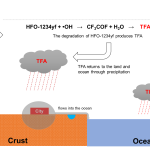
In the formation process of TFA, CFC alternatives such as HFCs/HFOs released from automobiles and air conditioning systems in cities flow upwards to the troposphere, where the compounds are further oxidized by •OH to form CF₃COX (X = F or Cl). CF₃COX is absorbed in clouds and rainwater and forms TFA through conversion in the liquid phase, finally depositing onto the Earth’s surface through precipitation scavenging or dry deposition. Precipitation is considered to be the major source of TFA in the biosphere.
Various works have simulated calculations of the TFA burden on the environment caused by CFC alternative degradation:
| Time Period | Total TFA Release (10,000 tons) | Annual Average Release (10,000 tons/year) | Release Source |
|---|---|---|---|
| 1930-1999 | 23-47 | 0.67 | All sources |
| 1990-2050 | 20,625 | 34.4 | HFC-134a, HFC-143a, HFC-227ea, HFO-1234yf |
| 2020-2050 | 695 | 23.2 | HFC-134a, HFO-1234yf |
| 2050-2100 | 4,170 | 83.4 | HFC-134a, HFO-1234yf |
The evaluation by the UN Environment Programme demonstrates that from the present and going up to 2050 and 2100, the TFA releases brought about exclusively by HFC-134a and HFO-1234yf would amount to 232,000 tons/year and 834,000 tons/year, respectively. The annual increase in TFA release is huge when third-generation CFC alternatives move to fourth-generation products. In the future, HFOs will become the main source of anthropogenic TFA in the environment. Most compounds containing a single terminal CF₃ group degrade ultimately to form TFA. Thus, many PFAS substances in the environment undergo degradation by various routes to produce TFA. Examples include the production of TFA from thermal decomposition of fluorinated polymer products during use or incineration and from microbiological degradation of fluorinated drugs and other fluorinated compounds in landfills. In general, the soil lacks retention capacity for TFA, and therefore TFA does not accumulate in soil. There is no obvious or significant degradation pathway for TFA. Once released into the environment, it exists as a freely dissolved salt in a deprotonated form and moves with water flow, accumulating in terminal water bodies, especially marine systems. At the same time, TFA is very stable in the environment and does not degrade easily; the half-life commonly exceeds one hundred years. Continued degradation and release of TFA due to widespread future use of HFOs will result in significant TFA accumulation in water bodies.