Shanghai, China – 20 November 2025
A team of researchers from Shanghai Jiao Tong University has unleashed a formidable new tool in the fight against per- and polyfluoroalkyl substances (PFAS), the notorious “forever chemicals” that persist indefinitely in water and pose severe health risks. Their study, published today in Nature Communications, described a new amphipathic fluoroamine hydrogel, QFgel, which selectively and efficiently removes PFAS from drinking water, industrial effluent, and even complex natural sources.
Traditional adsorbents such as activated carbons and ion-exchange resins face certain limitations: low capacity, slow kinetics, and poor regeneration for the ultra-low, parts-per-trillion concentrations common in real-world PFAS contamination. QFgel overcomes these limits by marrying two tailored binding sites in one material: fluorinated chains attract PFAS tails through fluorine-fluorine interactions, while the quaternary ammonium groups capture the anionic heads via strong electrostatic forces.
Key Performance Metrics
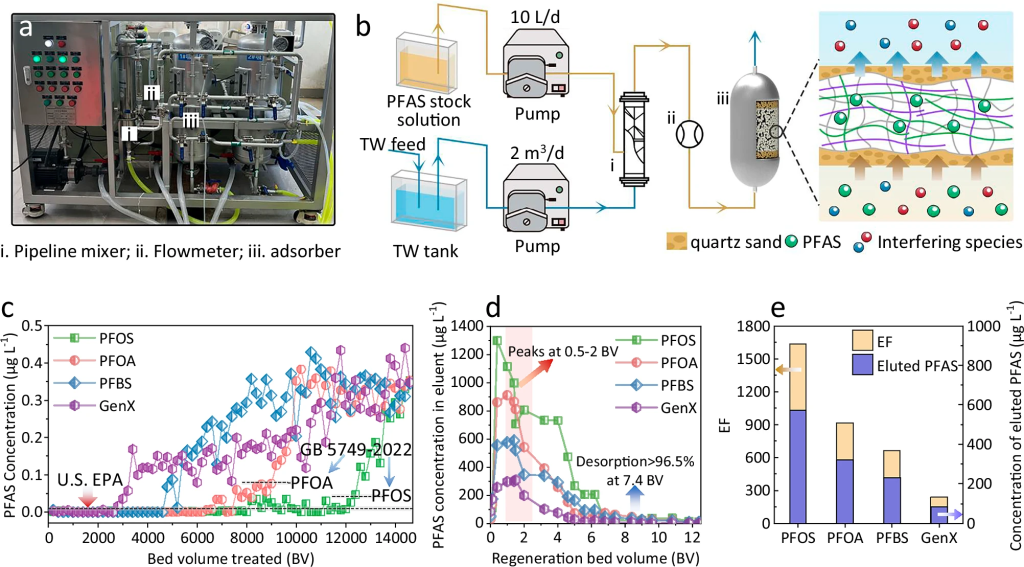
- Removal efficiency: >95% for PFOS, PFOA, PFBS, and GenX within 30 minutes
- Maximum capacity: 2,835 mg/g for PFOS (several times higher than leading sorbents)
- Pilot-scale performance: >80 m³ of water meeting EPA health advisory levels
- Concentration factor: Up to 1,600-fold during regeneration
The sponge-like gel, synthesized in a single, room-temperature pot from low-cost cellulose nanofibres and commercial monomers, is already being produced at kilogram scale. In laboratory tests it achieved more than 95% removal of legacy pollutants (PFOS, PFOA), short-chain substitutes (PFBS) and next-generation alternatives such as GenX within 30 minutes, while maintaining performance in lake and tap water laden with competing ions and organic matter.
A pilot-scale plant that treated 2 m³/day of PFAS-spiked tap water ran continuously for 70 days, delivering more than 80 m³ of water that met US EPA health advisory levels before breakthrough. Regeneration only required 7.4 bed volumes of a saline/methanol mix and concentrated the captured PFAS up to 1,600-fold, thus allowing low-cost reuse of the gel.
“Matching the amphiphilic chemistry of the pollutant in the sorbent itself unlocks both selectivity and speed.”
– Dr. Kaixing Fu, Lead Author
Corresponding author Prof. Jinming Luo adds that QFgel’s simple synthesis and scalable fabrication make it “a practical, affordable tool for households, municipalities and industries battling forever chemicals worldwide.”
The team is now expanding the platform to include zwitterionic and non-ionic PFAS emerging from lithium-battery manufacturing and partnering with water utilities for deploying full-scale columns in 2026.
Reference:
Fu, K., Luo, F., Fang, Z. et al. Amphipathic fluoroamine-functionalized hydrogels for enhanced selective removal of anionic pfas from water. Nat Commun 16, 10152 (2025). https://doi.org/10.1038/s41467-025-65031-4