

Toronto–Berkeley, 30 December 2025 — A peer-reviewed commentary released ahead of final publication in Nature Communications delivers an inconvenient message to the fast-growing PFAS-remediation industry: the very fluorinated materials hailed as breakthrough sorbents could be seeding the next wave of per- and polyfluoroalkyl contamination in drinking-water sources, soils and landfill leachate.
The paper, led by environmental chemist Da Chen of Jinan University’s Guangdong Key Laboratory together with co-authors Robert J. Letcher (Environment and Climate Change Canada), Miriam Diamond (University of Toronto) and Arlene Blum (Green Science Policy Institute), is the first to trace the full life-cycle of fluorine-functionalized adsorbents—from factory synthesis to eventual incineration or burial—and to quantify their potential to release new PFAS-like molecules at every step.
PFAS: too successful for its own good
PFAS have been manufactured since the 1950s for their unrivalled oil- and water-repellent properties. The same carbon–fluorine backbone that makes them valuable also makes them almost indestructible. With growing evidence linking long-chain PFAS to immune suppression, thyroid disease and kidney cancer, the U.S. Environmental Protection Agency in May 2025 reaffirmed a 4.0 ng/L Maximum Contaminant Level for PFOA and PFOS, while the EU, Canada and China have enacted similarly stringent limits. Conventional treatments—granular activated carbon, anion-exchange resins, reverse osmosis—can exceed these limits in pilot plants, but operating costs rise steeply when short-chain or ultrashort-chain PFAS such as trifluoroacetic acid (TFA) are present.
The lure of fluorophilic sorbents
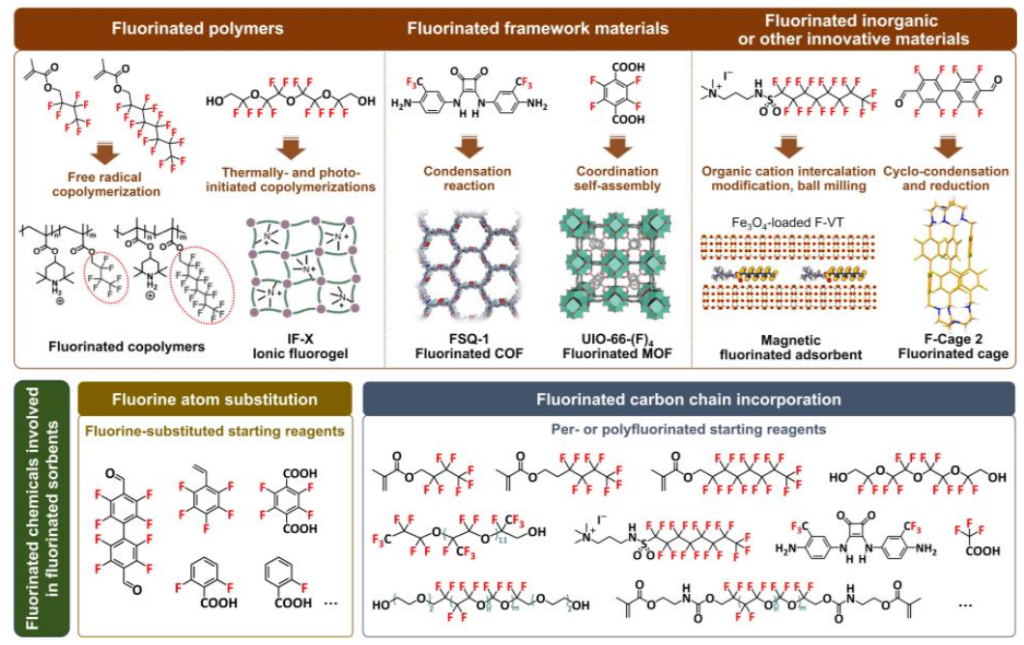
Over the past five years more than 100 papers have touted a simple fix: build sorbents that “speak fluent fluorine.” By grafting perfluoroalkyl side chains onto polymer beads, metal-organic frameworks (MOFs), covalent organic frameworks (COFs) or magnetic vermiculite, researchers report distribution coefficients for PFOA that exceed those of activated carbon by two orders of magnitude. The mechanism, known as fluorine–fluorine (F···F) interactions, is said to favour selective docking of PFAS even in the presence of natural organic matter that normally clogs adsorption sites. Venture capital has followed: at least six start-ups in North America and Europe have raised over US $180 million since 2022 to commercialize fluorinated “molecular traps.”
No universal advantage found
The Nature Communications team carried out a meta-analysis of 63 bench-scale studies and found no statistically significant correlation between fluorine loading and PFOA uptake once surface area and pore volume were normalized. “In several cases fluorination actually depressed performance,” notes co-author Shuqin Liu, a post-doctoral researcher at Jinan University. “When you stick a rigid perfluorohexyl chain into a MOF cavity you can block the very windows that PFAS need to diffuse through.” More importantly, nearly all data were generated in de-ionized water spiked with a single PFAS at mg/L levels—conditions that bear little resemblance to raw surface water where PFAS occur at ng/L and coexist with bicarbonate, sulphate, humic acids and micro-particles. Under standardized matrices that mimic Great Lakes water, the advantage of fluorinated sorbents over advanced non-fluorine alternatives—such as zirconium-based MOFs or cationic β-cyclodextrin polymers—shrinks to within experimental error.
Life-cycle blind spot
Perhaps the most sobering section of the paper inventories the fluorinated building blocks themselves: 1H,1H-perfluorooctyl methacrylate, N,N,N-trimethyl-3-(perfluorooctyl-sulfonamido)propan-1-aminium iodide, perfluoropolyether diacrylate and TFA. Under OECD’s 2021 definition any molecule containing at least one perfluorinated methyl (-CF₃) or methylene (-CF₂-) group qualifies as PFAS. “That means many of the ‘precursors’ are themselves PFAS,” Blum points out. “You can’t claim to be removing forever chemicals if you start by making them.”
The authors outline three release windows:
- Manufacturing: direct fluorination and telomerisation reactions generate 3–7 % by-weight residues that are either low-molecular PFAS or volatile fluorotelomer alcohols. Poor containment at Asian and U.S. pilot plants has already triggered local groundwater alerts in two industrial parks, according to supplementary data filed with the paper.
- Operation: EPA chemists reported in 2022 that fluorinated HDPE containers leached 70–650 ng/L total PFAS within one week; the new study shows analogous leaching from fluorinated ionogels and magnetic vermiculite when pH drops below 6.5 or chloride exceeds 100 mg/L—common in coastal aquifers.
- End-of-life: landfill incubations at 37 °C revealed slow but steady conversion of fluorotelomer-based polymers to PFOA and PFNA at yields of 0.03 % per year, enough to keep leachate above 20 ng/L for decades. Under incineration conditions typical for municipal solid-waste plants (850 °C, 2 s residence) the team measured formation of tetrafluoromethane and hexafluoroethane—potent greenhouse gases with 100-year CO₂-equivalents of 7,400 and 11,100, respectively—as well as detectable levels of fluorinated dibenzo-p-dioxins.
Regulatory crossroads
Because several precursors fall under the Stockholm Convention’s scope for PFOA-related compounds, the paper argues that commercial deployment without prior notification could violate treaty obligations. Canada and the EU are already considering expanding their PFAS restriction proposals to include “polymers of concern”; fluorinated sorbents could be swept into that net as early as 2026.
A call for non-fluorine innovation
Rather than impose a moratorium, the authors recommend a three-point pivot:
• Redirect at least 50 % of public PFAS-remediation funds to fluorine-free sorbents, membranes and destructive technologies such as electrochemical oxidation or supercritical water.
• Make life-cycle assessment and leachate testing prerequisites for pilot grants, using both targeted and non-targeted high-resolution mass spectrometry.
• Establish an international reference protocol—similar to the OECD’s adsorption–desorption ring test for pesticides—that forces developers to report capacity, kinetics and regeneration in natural water, not just ultrapure water.
Industry reaction
In a written response, the Fluorinated Sorbent Technology Alliance—whose members include three U.S. MOF start-ups—said it “welcomes evidence-based standards” and announced a voluntary programme to share leachate data by 2027. However, the group maintains that “selective F···F chemistry remains the fastest path to parts-per-trillion cleanup goals.”
Academic view
Veronica Verduzco, a materials engineer at Rice University who was not involved in the study, calls the paper “a timely counterweight to the hype cycle. The community has been publishing record uptake values without asking where the fluorine goes once the column is regenerated or landfilled. This work connects those dots.”
Next steps
The research team has launched a 24-month project with China’s Ministry of Ecology and Environment to pilot non-fluorine cationic COF beads at a 50 m³/day groundwater treatment site in the Yangtze River Delta. Data on capacity decline, regeneration energy and life-cycle emissions will be made public every quarter through an open-access dashboard. “We want to prove that you can hit 4 ng/L without creating tomorrow’s liability,” Chen said.
For policy makers, the message is blunt: solutions that silently replenish the PFAS inventory are no solutions at all. Whether the market—and the regulators—will heed the warning before large-scale deployment becomes entrenched is the next chapter in the forever-chemical saga.
Source:
Liu, S., Letcher, R.J., Diamond, M.L. et al. Unforeseen risks due to the use of fluorinated materials for per- and polyfluoroalkyl substance removal. Nat Commun (2025). https://doi.org/10.1038/s41467-025-67596-6