

Source: Environment International | 2026
For years, perfluorooctanoic acid (PFOA) has been one of the most notorious members of the so-called “forever chemicals” family — synthetic compounds so chemically stable they persist indefinitely in the environment and accumulate in living organisms. After a global ban was recommended under the Stockholm Convention in 2019, chemical manufacturers moved swiftly to introduce alternatives. But a new study published in Environment International delivers a sobering finding: one of the most widely adopted substitutes, hexafluoropropylene oxide trimer acid (HFPO-TA), may pose even greater risks to aquatic life than the compound it was designed to replace.
Out With the Old, In With the Unknown
Per- and polyfluoroalkyl substances (PFASs) are a broad class of synthetic chemicals used extensively in industrial and consumer products. Their extraordinary resistance to heat, water, and chemical degradation — a product of the carbon-fluorine bond, one of the strongest in organic chemistry — has earned them the label “forever chemicals.” PFOA, a prototypical member of this family, was phased out following mounting evidence of its environmental persistence and toxicity.
HFPO-TA emerged as a leading next-generation alternative. Designed with a shorter carbon chain and ether linkages, it was intended to metabolize more quickly and accumulate less readily in biological systems. Yet its growing industrial use has led to widespread environmental contamination. Since a landmark 2017 report detected HFPO-TA at concentrations as high as 68.5 μg/L in China’s Xiaoqing River — with an estimated annual discharge of 4.6 metric tons — the compound has been found in environmental samples worldwide, and in the bodies of both wildlife and people living near fluoropolymer manufacturing sites.
Putting Two Pollutants Head to Head
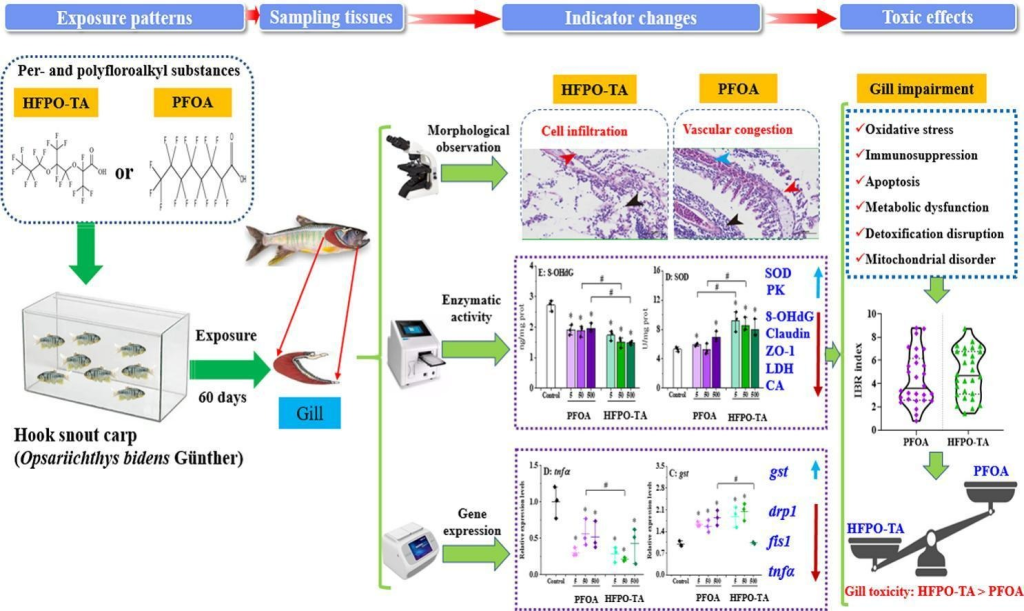
Researchers from Zhejiang University and collaborating institutions set out to directly compare the toxic effects of PFOA and HFPO-TA on a commercially and ecologically important freshwater fish: the hook snout carp (Opsariichthys bidens), widely distributed across Asia. Juvenile fish were exposed for 60 days to equivalent concentrations of each compound — low (5 μg/L), medium (50 μg/L), and high (500 μg/L) — mirroring levels commonly detected in natural surface waters.
The study focused on gill tissue, and for good reason. Fish gills are multifunctional organs responsible for gas exchange, ion regulation, acid-base balance, osmotic stability, and immune defense. As the direct interface between the fish and its aquatic environment, the gill is among the first organs to register the effects of waterborne pollutants, making it a sensitive and informative target for toxicological assessment.
A Consistent Pattern: The Substitute Does More Damage
Across nearly every endpoint measured, HFPO-TA outpaced PFOA in the severity of harm it caused.
Structural damage. Histological analysis revealed that high-concentration exposure to both compounds caused disordered arrangement, detachment, and necrosis of gill lamellae. These structural lesions are likely to impair the organ’s core physiological functions, with cascading consequences for fish health and survival.
Oxidative stress and antioxidant defense. Both compounds triggered activation of antioxidant enzymes (SOD and CAT), reflecting the fish’s attempt to neutralize excess reactive oxygen species (ROS). However, at the gene expression level, HFPO-TA more severely suppressed the transcription of key antioxidant genes (sod and cat), suggesting it overwhelms the cell’s defenses more comprehensively.
DNA repair suppression. Unexpectedly, levels of 8-OHdG — a standard biomarker of oxidative DNA damage — declined rather than rose following exposure to both PFASs. The researchers interpret this not as a sign of reduced damage, but as evidence of impaired DNA repair pathways. Crucially, the suppression was more pronounced under most HFPO-TA treatments, suggesting a greater potential for genotoxic harm.
Immunosuppression. Both compounds broadly suppressed the expression of pro-inflammatory cytokines TNF-α and IL-1β in gill tissues — a sign of weakened innate immunity. HFPO-TA produced a stronger immunosuppressive effect, potentially leaving fish more vulnerable to infectious disease and further environmental stress.
Mitochondrial dysfunction. Genes governing mitochondrial fission (drp1, fis1) and biogenesis (nrf1) were downregulated under both compounds, impairing the cell’s ability to clear damaged mitochondria and maintain energy production. The suppression was more severe following HFPO-TA exposure, pointing to deeper disruption of cellular energy metabolism.
Epithelial barrier integrity. Tight junction proteins — Claudin, Occludin, and ZO-1 — were reduced under both PFOA and HFPO-TA treatments, compromising the gill’s structural barrier. Gene expression data reinforced this picture, with HFPO-TA driving more pronounced downregulation of zo-1 across all exposure groups.
To integrate these findings into a single comparative metric, the researchers applied an Integrated Biomarker Response (IBR) index — a tool that synthesizes multiple biological endpoints into an overall toxicity score. The IBR analysis confirmed what individual indicators suggested: across all tested concentrations, HFPO-TA imposed a higher overall toxic burden on O. bidens than PFOA.
Rethinking the Regulatory Logic
The implications of this research extend well beyond fish biology. The regulatory framework governing chemical substitution rests on an assumption that next-generation replacements are safer than the compounds they succeed. This study directly challenges that assumption.
“HFPO-TA might not be a safe substitute for PFOA,” the authors state plainly. They call for mandatory, comprehensive toxicological evaluation of emerging PFAS alternatives before they are permitted to enter widespread production and use — a standard that, the findings suggest, was not adequately applied to HFPO-TA.
The researchers also acknowledge the limits of the current work. Whether findings in O. bidens generalize to other fish species and life stages remains to be established. Long-term exposure effects and the reversibility of observed damage after exposure ends are open questions requiring further investigation.
The Broader Picture
The story of PFOA and HFPO-TA reflects a pattern familiar in environmental toxicology: a chemical is banned after its harms become undeniable, only for its replacement to enter the market before its own risks are fully understood. By the time the science catches up, the substitute has already accumulated widely in rivers, fish, and human bodies.
This study adds to a growing body of evidence that the “forever chemicals” problem cannot be solved simply by redesigning individual molecules. Aquatic ecosystems are now receiving a steady influx of novel PFAS compounds whose toxicological profiles are largely uncharacterized. As the authors argue, safeguarding these ecosystems will require not only better science, but faster and more rigorous regulatory action — one that evaluates substitutes as skeptically as the compounds they replace.