International seafood commerce is dramatically altering human exposure to toxic PFAS compounds, with European trade networks playing a pivotal role in spreading contamination
December 19, 2025 — A comprehensive new study published in Science has unveiled how the global fish trade is fundamentally reshaping human exposure to per- and polyfluoroalkyl substances (PFAS) — persistent environmental contaminants known as “forever chemicals” that can remain in ecosystems for decades.
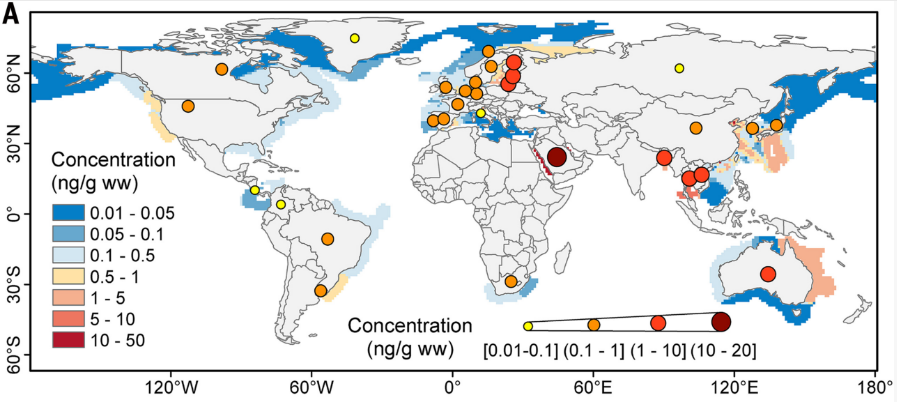
The research, led by Wenhui Qiu and colleagues from multiple international institutions, analyzed PFAS concentrations in 212 marine fish species across the globe, revealing that international trade routes are transferring contamination from high-pollution regions to areas that would otherwise face lower exposure risks.
Europe Emerges as Key PFAS Transfer Hub
The study found that European countries play an outsized role in redistributing PFAS through fish exports. Sweden and Finland stand out as major exporters, contributing over 0.35 nanograms per kilogram per day of PFAS exposure to importing nations. Strikingly, imports account for nearly 77% of Lithuania’s PFAS exposure and 82% of Estonia’s exposure from marine fish consumption, driven primarily by salmon and herring imports.
In Italy, imported Swedish fish represent only 12% of total consumption but contribute a disproportionate 36% of the country’s PFAS exposure from seafood. Meanwhile, locally caught fish — comprising 28% of Italian consumption — account for just 5% of PFAS intake.
“The global food trade has the potential to reshape the landscape of PFAS exposure,” the researchers note, highlighting how contamination follows commercial pathways rather than just environmental dispersal.
Geographic Hotspots Identified
The study mapped global PFAS contamination patterns, finding median concentrations of 0.34 nanograms per gram in marine fish from 2010 to 2021. Asia and Oceania showed higher-than-average concentrations, with particularly elevated levels in Saudi Arabia, Thailand, and along Australia’s east coast.
North America, Oceania, and Europe exhibited the highest estimated daily intake (EDI) of PFAS from marine fish consumption. The global population-weighted EDI was calculated at 0.023 nanograms per kilogram per day, with high-income countries showing intake levels nearly six times higher than other nations.
Mixed Results from International Regulations
The research assessed the effectiveness of the 2009 Stockholm Convention, which restricted perfluorooctane sulfonate (PFOS). Results showed the hazard index for PFOS decreased by 72% globally following regulations, with particularly strong improvements in the United States and Canada, where policies were implemented even earlier.
However, the picture is less encouraging in some regions. Several European Union countries continue to show rising PFOS concentrations in marine fish despite implementing regulations in 2006, suggesting limited policy effectiveness. Countries with more recent regulations, including Brazil and Australia, still show increasing contamination trends.
Unregulated Long-Chain PFAS Pose Elevated Risks
Perhaps most concerning, the study revealed that certain unregulated long-chain PFAS compounds — including perfluorodecanoic acid, perfluorononanoic acid, and perfluoroundecanoic acid — pose higher health risks than the regulated PFOS and PFOA due to their greater bioaccumulation potential and toxicity.
“Although emissions of regulated C8-PFAS have markedly decreased, unregulated long-chain PFAS remain a concern,” the authors warn. These compounds showed hazard index values exceeding safe thresholds in parts of Europe and North America, indicating potential health risks in regions with historically high production.
Methodology and Implications
The research integrated multiple data sources: a marine food web bioaccumulation model, seawater PFAS monitoring from 3,126 sites worldwide over 20 years, global fish catch data at fine geographic resolution, and international trade records. The team also collected and analyzed 150 marine fish samples from 87 species across 14 countries to validate their predictions.
The study’s framework offers a new tool for policymakers to identify high-risk trade pathways and implement targeted food safety inspections. The researchers suggest monitoring exports from high-contamination countries and specific fish species known to accumulate PFAS at higher trophic levels.
Call for Strengthened Global Cooperation
The findings underscore the need for harmonized international standards, as current regulations vary dramatically between countries — with some nations lacking PFAS limits entirely. The researchers emphasize that while international trade enriches global diets, it also necessitates coordinated efforts to prevent the spread of persistent contaminants.
“Our study highlights an urgency for strengthening global cooperation and policies to minimize human exposure to PFAS from marine fish consumption,” the authors conclude, calling for advancement of international fish trade guidelines and tightened control of long-chain PFAS compounds.
The research contributes to mounting evidence that PFAS contamination represents a global challenge requiring coordinated international action, as these “forever chemicals” continue to circulate through environmental systems and food supply chains decades after their release.
Reference: Qiu, W., et al. (2025). Risks of per- and polyfluoroalkyl substance exposure through marine fish consumption. Science, 390(6779), 1305-1309.