
Veneto, Italy | November 12, 2025
A landmark epidemiological study published today provides the most compelling evidence to date of a causal link between long-term exposure to PFAS-so-called “forever chemicals”-and increased mortality rates. Researchers, led by economist Luca Facchinello at Italy’s Collegio Carlo Alberto, have analyzed more than three decades of data from Europe’s largest PFAS contamination incident, which contaminated 140,000 residents in Italy’s Veneto region. The results, updated on SSRN in recent days, fundamentally challenge current European Union and U.S. regulatory standards by showing that even exposure levels currently considered “safe” result in significant excess deaths.
The study estimates that the contamination has caused over 1,600 premature deaths between 1982 and 2012 alone, with mortality-related costs estimated to have surpassed €5.2 billion.
A Three-Decade Public Health Catastrophe
PFAS are a family of man-made chemicals that have been produced in industry since the 1950s. Most valued for their unique water-, grease-, and heat-resistant properties, they have been utilized in thousands of products, such as coatings in non-stick cookware, materials in food packaging, and firefighting foams. The carbon-fluorine bond is one of the strongest in nature, making PFAS practically indestructible and leading to persistent accumulation in water systems, soil, and human blood. Approximately 200 million people around the world consume drinking water contaminated with at least 1 nanogram per liter of the two most common PFAS compounds: perfluorooctanoic acid (PFOA) and perfluorooctanesulfonic acid (PFOS).
The Veneto contamination began in 1969 when a chemical plant in Trissino commenced large-scale PFOA production. Improper waste disposal practices allowed a contamination plume to spread through groundwater and reach public water wells serving 27 municipalities by the mid-1980s. For three decades, residents unknowingly consumed contaminated water until routine monitoring finally exposed the disaster in 2013. Testing revealed average PFAS concentrations of 291 ng/L in tap water—three times Italy’s current legal limit but within the EU’s forthcoming 500 ng/L total PFAS threshold.
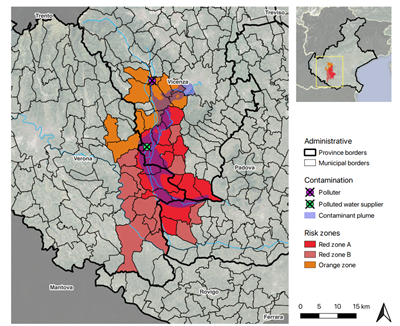
Figure : Contaminant plume and risk zonesThe contaminant plume originated by Miteni covers a large area, spanning the provinces of Vicenza, Verona and Padova, where the wells used by Lonigo’s water supplier are located. Resulting risk zones are based on the 2018 Veneto Region definition and adjusted to reflect actual underground water contamination.
Innovative Research Design and Key Findings
Facchinello used the sharp boundary of the polluted water network to create a “geographic quasi-experiment.” The study compared age-standardized mortality rates in municipalities just inside the polluted “Red Zone” with demographically similar neighboring communities outside it, ensuring comparability in income, education, and other socioeconomic factors. The study runs between 1982–2021 and relies on comprehensive administrative records of every resident and death.
Principal Results
1982–2012 Period:
Residents of the Red Zone faced an increased annual risk of mortality, which was 4% higher as compared to residents living in neighboring uncontaminated areas; this result is statistically significant.
2001–2012 Period:
The gap in mortality widened to 5%, with disproportionate effects on women and individuals over age 65.
Post-2013 (Following Exposure Cessation):
Despite source elimination, excess mortality has paradoxically risen to 7–10%; this finding is in keeping with PFAS’s long biological half-life and cumulative health damage.
Using difference-in-differences methodology, the authors separately analyzed the less-contaminated “Red Zone B,” to find mortality rates indistinguishable from clean areas until 2009, followed by an abrupt 7.5% increase during 2010-2013, then up to 12.5% in 2014-2017, with modest decline during the COVID-19 pandemic.
These findings stood up to several robustness checks, including: randomization inference, placebo boundary tests, and controls for air pollution, housing prices, migration patterns, and municipal expenditures.
Disparate Health Impacts Across Gender and Age
The research shows profound health inequalities:
Women demonstrated a more prominent U-shaped mortality pattern: no excess deaths, in fact, during the 1990s but 6-9% increases post-2000. According to researchers, this is due to the interaction of longer life expectancy for women, chronic inflammation, and immunosuppression induced by PFAS, finally resulting in increased cardiovascular disease, diabetes, and cancer mortality.
Men saw spikes in mortality in the 1990s in the population under age 65, which may be due to work exposures and smoking.
Elderly populations (ages 65–84) suffered the greatest cumulative impact, with excess mortality reaching 12% in certain years. Children and young adults were not spared: elevated death rates in the 1990s suggest pregnancy-related complications and infectious disease vulnerability during a period when Italy’s universal healthcare system was still developing.
Staggering Economic Toll
Using conservative value-of-statistical-life estimates, the study calculates that there were 1,635 excess deaths and €5.23 billion in mortality costs for the period 1982–2012 alone. Adding healthcare expenditures, lost earnings, and water infrastructure upgrades (an additional €200 million), the total social cost skyrockets. Facchinello explains that the most-cited estimate of annual health impacts from PFAS exposure by the Nordic Council ranges from €52 to 84 billion for all of Europe, which “likely represents a substantial underestimate.”
Regulatory Implications and Policy Challenges
Current EU regulations, effective in 2026, allow for drinking water PFAS concentrations of up to either 100 ng/L (sum of 20 priority PFAS) or 500 ng/L (total PFAS). The U.S. Environmental Protection Agency finalized more restrictive limits of 4 ng/L for PFOA and PFOS in 2024, though enforcement has been delayed until 2031.
The Veneto findings show that 291 ng/L exposure—well below both EU thresholds—produced a 7.5% mortality increase, indicating that “at least one EU standard fails to adequately protect against death.” Even applying a tenfold safety factor to a hypothetical 200 ng/L no-effect level yields 20 ng/L, far below the EU’s more permissive limit.
“The conclusion is unequivocal,” said Facchinello at a briefing for the press. “If we wait for more victims before taking action, we have already failed. Policy needs to focus on the elimination of non-essential uses of PFAS-not just on adapting the threshold values of concentrations.
Global Warning
Since the PFOA and PFOS-related restrictions under the Stockholm Convention, manufacturing has moved to countries with weaker regulations. On the other hand, the shorter-chain replacement chemical alternatives, previously considered safer, are more difficult to filter out, disperse more quickly, and have similar toxic profiles. The study expresses caution against “regrettable substitution” and appeals to low- and middle-income countries to establish blood and water monitoring prior to the development of contamination on a Veneto-scale.
European advocacy organisations immediately mobilised around the findings: “This paper gives grieving communities the evidence they need,” said a Health and Environment Alliance spokesperson. “The European Parliament must strengthen the Drinking Water Directive before the 2026 implementation deadline.
Future Research and Community Response
Facchinello intends to extend the analysis to cause-specific mortality and birth outcomes. A sister study has already found the same contamination responsible for lower elementary school test scores, which indicates economic damages from such hazards go far beyond mortality. For the residents of Veneto, the damage is irreversible. “We drank poison for 30 years,” said Maria Rossi, a retired teacher in Lonigo. “We welcome scientific validation of what we always suspected. Now we demand action—clean water and compensation.” As the EU and U.S. prepare multi-billion-euro remediation campaigns, the Veneto study delivers a stark message: when it comes to forever chemicals, so-called “safe” levels may be anything but safe.
Study Citation:
Facchinello, L. (2025). The Health Costs of PFAS Contamination: Evidence from Veneto, Italy. SSRN Electronic Journal. https://papers.ssrn.com/sol3/papers.cfm?abstract_id=5637650