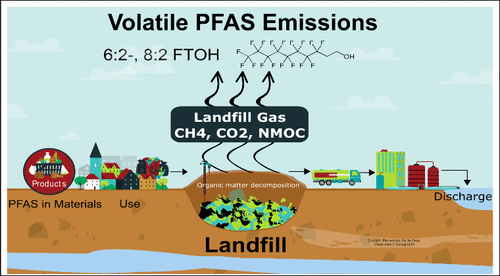
RALEIGH, NC — A sweeping national study has calculated that U.S. landfills emit an estimated 836 kilograms of the volatile classes of per- and polyfluoroalkyl substances (PFAS) each year via landfill gas, a previously underrecognized route of “forever chemicals” into the environment.
Groundbreaking Nationwide Assessment
The study, from North Carolina State University and Oregon State University researchers and published in Environmental Science & Technology, is the first nationwide estimate of PFAS emissions from landfill gas in the United States. It analyzed samples of landfill gas from 30 different landfills in 17 states, spanning regions from low to high precipitation.
Lead author Florentino B. De la Cruz and colleagues found that PFAS concentrations in landfill gas varied over several orders of magnitude, with a median concentration of 19,000 nanograms per cubic meter. Overall, the findings demonstrate that landfill gas emissions are equivalent to leachate releases, both in terms of magnitude of contaminant loading, and point to a significant environmental exposure pathway that has garnered substantially less attention.
Dominant PFAS Compounds Identified
Only 6:2 and 8:2 FTOH were detected as dominant PFAS in landfill gas, with concentrations over 95% of the total PFAS concentration. Minor components included fluorotelomer olefins, which were measured between 0-28,000 ng/m³ with a median of 316 ng/m³.
The influencing factors on the variability of PFAS concentrations included not only regional patterns in precipitation but also temporal and site-specific characteristics of individual landfills.
Comparable to Leachate Pathway
While often better-documented as a source of PFAS contamination, prior estimates suggested 600 kilograms of PFAS annually released into leachate; this new research will show that airborne emissions via landfill gas presents at least an equally significant pathway.
“These data are crucial for mapping the national and global mass flows of PFAS in the environment, which is fundamental for assessing related public health risks,” the researchers said in their study.
Sampling and Analytical Methods
Sampling of landfill gas by the research team was performed at multiple points within each facility, with multiple sites sampled several times to assess PFAS composition and changes over time. The research also assessed the impact of processes used downstream of the sample point to remove condensate prior to combustion in flares or internal combustion engines.
Samples were collected with multibed sorbent tubes and analyzed by TD-GC-MS, which enabled the precise identification and quantification of volatile PFAS compounds.
Environmental and Health Implications
The findings, he said, highlighted the complexity of PFAS contamination pathways from landfills. While leachate is usually treated at wastewater plants—though removal of PFAS is limited—the release of landfill gas represents a more direct path for the persistent chemicals to reach the atmosphere and wider environment.
PFAS are man-made chemicals that don’t break down easily in the environment and have been linked to reproductive issues, problems with the immune system, and cancer. They’re found in everything from food packaging to textiles, so most landfills contain waste with PFAS.
Call for Increased Monitoring
The authors of this study stress that their estimated figure of 836 kg/yr accounts for those emissions from landfill gas that are not collected, and thus directly released to the atmosphere. This finding would suggest that current environmental monitoring and risk assessment efforts may be significantly underestimating total PFAS releases from landfills.
This research underlines the need to go toward comprehensive strategies in order to face PFAS contamination, including liquid and gaseous emission pathways. This study brings crucial data as regulations around PFAS are constantly being updated for policymakers and environmental managers that work toward mitigating the effects of thesePersistent Pollutants.
Study Details
This study was conducted by Florentino B. De la Cruz, Ivan A. Titaley, Yixuan Wang, Jennifer A. Field and Morton A. Barlaz from the Department of Civil, Construction and Environmental Engineering of North Carolina State University; and the Department of Environmental and Molecular Toxicology of Oregon State University.
This study has been published in the journal Environmental Science & Technology, 2025; 59 (46):24899-24908. DOI: 10.1021/acs.est.5c08763