

Groundbreaking study links PFHpA exposure to fatty liver disease in adolescents with obesity
A new study, published in Communications Medicine, uncovers disturbing links between an unregulated chemical compound and liver disease in young people, which puts the spotlight on an environmental health threat to vulnerable populations that has previously been largely overlooked.
Researchers have pinpointed a short-chained “forever chemical” known as perfluoroheptanoic acid from the family of PFAS chemicals as a major risk factor in metabolic dysfunction-associated steatotic liver disease among adolescents with obesity. The study discovered that with each doubling of blood plasma PFHpA levels, the risk of developing this serious liver condition increased by 80%.
The Hidden Danger in Everyday Products
PFASs are man-made chemicals that have been used for over six decades in countless consumer products, from water-resistant clothing and nonstick cookware to food packaging. These compounds have obtained the nickname “forever chemicals” because they persist in the environment and accumulate in human bodies over time. Research demonstrates that over 99% of people in the United States have a detectable level of PFAS in their blood.
What is particularly worrisome about PFHpA, though, is that it is still not regulated, even after it has been found to accumulate in the liver at high concentrations. As longer-chain PFAAs, such as PFOA and PFOS, were phased out after they were found to have health effects, manufacturers introduced short-chain replacements like PFHpA, which were believed safer. At present, however, research suggests the replacements may pose similar health risks.
A Comprehensive Investigation
The research team, comprised of scientists from the University of Southern California and multiple medical centers, constructed a novel translational framework that integrated human clinical data with laboratory experiments to study how PFHpA affects the liver.
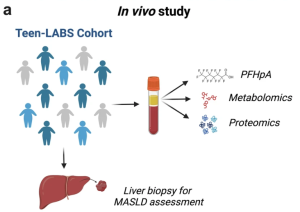
The study examined data from 136 adolescents participating in the Teen-LABS cohort, a multicenter study of youth with severe obesity who underwent bariatric surgery between 2007 and 2012. All the adolescents had liver biopsies examined by pathologists, and thus definitive diagnoses of liver disease were obtained. Of the participants, 40% did not have evidence of MASLD, while 38% had MASLD with no advanced inflammation, and 22% had developed MASH, a more aggressive form of the disease characterized by significant inflammation and liver damage.
Of eight various PFAS compounds measured in the participants’ blood, only PFHpA showed a significant association with liver disease. A clear dose-response relationship was observed: the higher the level of PFHpA, the greater the severity of the disease, including fat accumulation, cell damage, inflammation, and fibrosis in the liver.
Laboratory Confirmation
To investigate the biological basis for this link, researchers treated three-dimensional human liver tissue models—highly complex cell cultures that closely recreate real liver architecture—with PFHpA for a week. The effects were dramatic: the chemical elicited pronounced lipid buildup in liver cells and turned on specific molecular pathways that play roles in fat metabolism.
Single-cell genetic analysis showed that PFHpA disrupted lipid metabolism mainly in hepatocytes, the primary functional cells of the liver, through the activation of a protein called PPAR-alpha. This resulted in the upregulation of many pathways involved in fat production and storage, thus causing the liver cells to accumulate excess fat, which is essentially the hallmark of the disease fatty liver.
Molecular Fingerprints of Disease
The research team used advanced multi-omics analysis, studying thousands of metabolites and proteins in the participants’ blood simultaneously to identify the exact molecular signature linked to liver disease caused by PFHpA. Indeed, they found 48 metabolites and 55 proteins that indicated disturbed pathways related to lipid metabolism, inflammation, bile acid transport, and immune system activation.
In all, the analysis yielded two clear molecular profiles. One protein profile was associated with dramatically higher odds of MASLD-more than seven times greater than baseline-whereas a metabolite profile seemed to be partially protective. The high-risk protein profile included markers of inflammation and metabolic stress, several of which had been identified in other studies as associated with liver fibrosis progression.
Implications for Public Health
The findings have urgent implications for public health policy and clinical practice. Fatty liver disease has been rising dramatically among children in recent years, mirroring increases in childhood obesity. Though the condition affects an estimated five to ten percent of children overall, rates jump to 30-50% among children with obesity.
Traditional interventions include dietary changes, exercise programs, and even FDA-approved medications that have not been very successful in treating MASLD in adolescents. This reality underlines the critical need to identify and reduce exposure to environmental risk factors such as PFHpA.
The lead investigators of this study underscored that PFHpA is but one member of a large family of PFAS compounds, most of which are unregulated and understudied. These results provide a template for the investigation of other PFAS chemicals and their potential health effects by similar translational approaches.
Mechanisms of Harm
The study highlighted a variety of ways in which PFHpA seems to encourage liver disease. In addition to making fat accumulate in liver cells, the chemical initiated inflammatory reactions that include many immune signaling molecules. The researchers noted abnormalities in processes mediated by interleukins and other cytokines—substances that control inflammation, and whose chronic elevation may modulate fat metabolism.
Of particular note, PFHpA exposure decreased blood levels of various beneficial compounds, including the anti-inflammatory amino acids tryptophan and glycine, as well as specific bile acids involved in fat digestion and liver function. This indicates that PFHpA interferes with multiple interrelated metabolic processes.
A Call for Action
The researchers underline that, though their study focused on adolescents with obesity-a particularly vulnerable population-the findings have broader relevance. The biological mechanisms identified could affect people across different age groups and body weights, especially given the ubiquitous nature of PFAS exposure in modern life.
The authors of this study conclude by calling for increased regulatory attention to the short-chain PFAS compounds, such as PFHpA, which have largely escaped the scrutiny applied to their longer-chain predecessors. They also note the need for clinical strategies to identify individuals at high risk for PFAS-induced liver disease, possibly using the molecular signatures identified in their research.
Because fatty liver disease is increasingly prevalent in young people, there is an increased interest in understanding the contribution of environmental chemicals. The data in this study provide strong support for a preventive strategy to reduce PFAS exposure, complementary to traditional preventive strategies based on diet and exercise.
The study shows the power of combining population-based research with experimental laboratory work to uncover environmental health threats. Using human clinical data in concert with mechanistic studies enables researchers to do more than identify associations of concern but understand the biological pathways involved, which is crucial for developing targeted interventions and making evidence-based policy decisions.
For families and individuals who are concerned about exposure to PFAS, experts recommend reducing contact with products known to contain them. That would include some nonstick cookware, stain-resistant treatments, and fast-food packaging. Although total avoidance of PFAS in modern society remains difficult, awareness and informed consumer choices can be very important for the prevention of unnecessary exposure, especially among children and adolescents.
Source: Baumert, B.O., Maretti-Mira, A.C., Walker, D.I. et al. Translational framework linking perfluoroheptanoic acid (PFHpA) exposure to metabolic dysfunction associated steatotic liver disease in adolescents. Communications Medicine 5, 430 (2025). https://doi.org/10.1038/s43856-025-01168-z