A comprehensive review published in the journal Environments traces the decades-long journey of per- and polyfluoroalkyl substances (PFAS) research, from celebrated “miracle chemicals” to one of the most pressing environmental health concerns of our time.
The Rise of Forever Chemicals
It all began in 1938 when Dr. Roy J. Plunkett, working for DuPont at its laboratory in New Jersey, accidentally discovered PTFE. The accidental discovery of PTFE, followed by the invention of the electrofluorochemical process in 1942, ushered in an industrial revolution. Because of their remarkable stability and ability to repel both water and oil, PFAS were soon found in everyday consumer products, including non-stick cookware, stain-resistant fabrics, firefighting foams, and food packaging.
These chemicals were long regarded as industrial wonders. For years, 3M and DuPont have been leading manufacturers, producing thousands of products with PFAS that became indispensable in everyday life. This success story masked a darker reality that would only become apparent years later.
The Turning Point
The turning point arrived in 1998 when 3M informed the EPA that PFOS had been found in human blood and was persisting in the environment. This discovery motivated the company to begin phasing out PFOS-based products from 2000 to 2002, which launched comprehensive scientific examination of these chemicals.
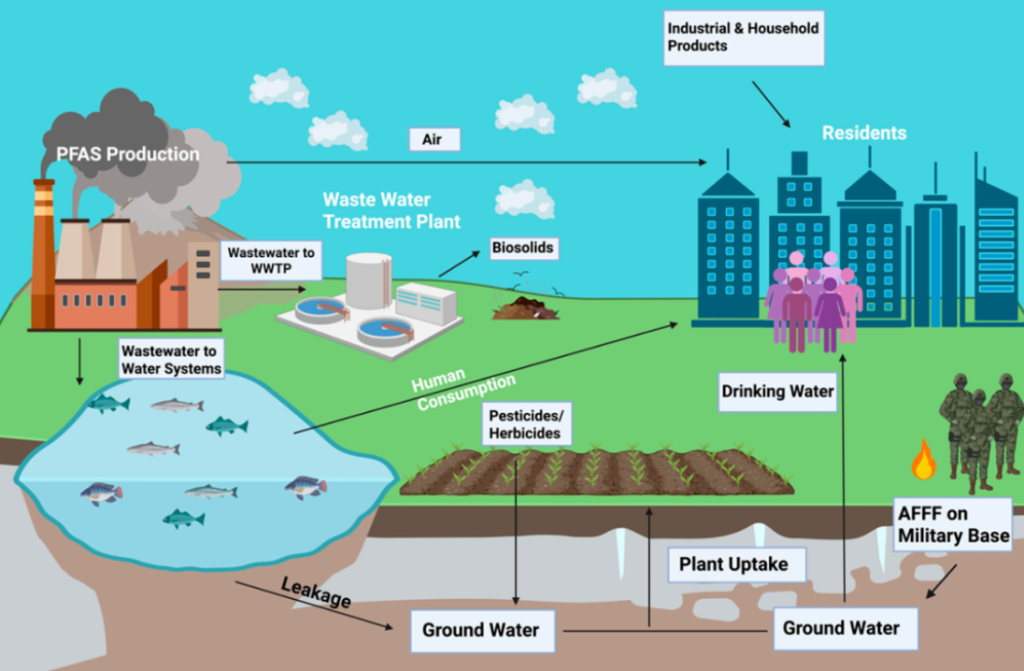
The 2000s saw an explosion of environmental studies documenting PFAS contamination around the world. Researchers found these substances in rivers, groundwater, sediments, and oceanic waters—from the Mississippi River to the Yellow Sea. Most disturbingly, PFAS built up in the tissues of wildlife, with exceptionally high concentrations in the livers, kidneys, and blood of marine mammals and fish.
Human Health Implications
The 2010s turned attention to human health effects. The seminal C8 Health Project of close to 70,000 participants around a West Virginia chemical plant showed high levels of PFOA in exposed populations. Subsequent research linked PFAS exposure to liver toxicity, thyroid disease, developmental malformations, and immune system weakness, among other health issues.
Laboratory studies revealed that PFAS disturbed lipid metabolic processes, induced oxidative stress, and even mitochondrial dysfunction in various cell types. Animal models presented hepatotoxicity, nephrotoxicity, and neurodevelopmental effects, which all together give a rather disturbing picture of the biological effects of these chemicals.
Scientific and Regulatory Response
Research has advanced spectacularly since 2020 with the adoption of omics technologies—proteomics, transcriptomics, and metabolomics—which have provided insights at the molecular level into PFAS toxicity mechanisms. Scientists found out that PFAS activated cellular pathways of fat metabolism and xenobiotic processing which accounted for so many observed health effects.
Besides, parallel developments came out in detection and removal technologies. In addition to traditional methods, which remained gold standards, such as liquid chromatography-mass spectrometry, researchers developed innovative biosensors, metal-organic frameworks, and bacterial remediation approaches. However, short-chain PFAS—introduced as “safer” alternatives—proved particularly challenging to remove due to their high water solubility.
Regulatory efforts continued to ramp up under the Biden Administration. In April 2024, the EPA set the first national drinking water standards for six PFAS compounds and labeled PFOS and PFOA as hazardous substances. These rules marked significant milestones in trying to tackle contaminated water supplies that had spanned decades.
Current Challenges and Future Directions
Despite progress, substantial knowledge gaps still exist. Critical challenges identified in this review include the following: short-chain PFAS continue to contaminate water systems with no universally effective removal strategy; long-term health impacts remain uncertain, in particular regarding chronic disease interactions; and no medical treatments exist to remove PFAS from human bodies.
The global dimension makes things more complicated, as production facilities have merely been moved to Asia—but particularly China—since Western nations have tightened their regulatory frameworks. This geographical shift underlines the need for international cooperation on chemical management.
Looking Ahead
The review concludes that future studies should only be directed toward the development of PFAS-free alternatives, improving therapeutic approaches in human exposure, and enhancing regulatory frameworks globally. Scientists are calling for continued investigation into epigenetic effects, metabolomic changes, and miRNA-mediated pathways to understand these chemicals’ biological impacts.
As the lead author Phuong D. Tran notes: “Despite these accomplishments, much remains uncertain about the long-term impacts of PFAS. Further research and a collective action program is needed to ensure environmental and public health safety for future generations.”
The story of PFAS is a cautionary tale of the unintended outcome of chemical innovation: from industrial chemistry marvel to an ongoing complex environmental and health problem that requires sustained scientific, regulatory, and public health responses. The next chapter in this ongoing saga will likely be written on remediation technologies, alternative chemistries, and protection of future generations from the legacy of these ultra-persistent pollutants.
Published: December 2025
Journal: Environments
DOI: 10.3390/environments12120476