
Comprehensive research across 16 cetacean species finds that “forever chemicals” pose a consistent, worrying threat, regardless of ocean habitat.
A landmark study investigating “forever chemical” contamination among New Zealand’s diverse cetacean population has yielded a surprising and troubling result: These persistent pollutants are threatening marine mammals equally, whether they inhabit shallow coastal waters or the crushing pressures of the deep ocean. The research, which has just appeared in Science of the Total Environment, meticulously quantified PFAS levels in 127 individual animals, representing 16 distinct species of toothed whales, dolphins, and porpoises.
The Study: Looking Beyond the Coastline
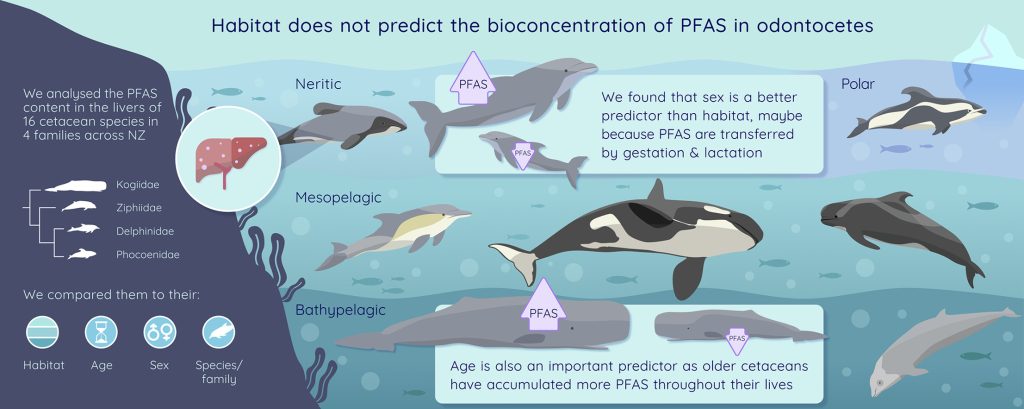
Researchers from Massey University analyzed a liver tissue collection sourced from stranded cetaceans collected along New Zealand’s coastline between 2009 and 2022. This extensive survey covered four cetacean families—Delphinidae (dolphins), Ziphiidae (beaked whales), Phocoenidae (porpoises), and Kogiidae (pygmy sperm whales)—across four vastly different marine environments: neritic (shallow coastal), mesopelagic (mid-depth), bathypelagic (deep ocean), and polar waters.
Their team measured the concentrations of 20 different PFAS compounds. Crucially, the authors employed advanced statistical modeling to investigate the influence of various factors, such as habitat, sex, age, and species, on the observed PFAS accumulation patterns.
Unanticipated Outcomes: Habitat Takes a Back Seat
The results flew in the face of scientific convention. Contrary to what researchers would typically expect, marine habitat proved to be a weak predictor for the PFAS burden in this animal cohort. This is counter-intuitive, as coastal species are usually assumed to face higher exposure to local contamination from industrial runoff, agricultural waste, and urban discharge points.
“We fully anticipated seeing clear, distinct differences between species feeding in shallow coastal waters versus those residing in the deep ocean,” said lead researcher Professor Karen Stockin. “Instead, what dominated the results was the finding that biological factors—specifically sex and age—were the main drivers of PFAS levels across all habitats.”
Total concentrations of PFAS across all samples spanned up to $146.5 tissue. Mesopelagic species recorded the overall highest mean concentration at $37.6, with bathypelagic species following at $14.4. Neritic and polar species showed intermediate values.
Sex and Age Matter Most
The statistical analysis painted a clear, striking picture centered on biology, not environment. Males from all examined cetacean species consistently had higher PFAS concentrations than females. This difference is directly attributed to maternal offloading, which is the biological process of transferring contaminants from mothers to their offspring during gestation and lactation.
Age also played a critical, if complex, role: while longer exposure generally leads to higher contaminant levels in older animals, this specific study observed that concentrations of non-precursor PFAS often decreased with age in many cases. Conversely, precursor compounds showed the opposite, increasing with body size and age.
Co-author Dr. Katharina Peters commented that these patterns strongly suggest that physiological processes, reproductive history, and metabolic differences are the crucial drivers of how these chemicals accumulate. The unfortunate corollary is that while female cetaceans reduce their own PFAS burden, juveniles face elevated exposure through that maternal transfer.
Chemical Profiles Vary by Depth
Although the total PFAS burdens were surprisingly uniform across habitats, there was a marked difference in the specific suite of chemicals detected between deep-diving and shallow-water species. For instance, PFSAs dominated the PFAS profile of the coastal neritic species, representing $56.9 of the total contamination, whereas in the deep-diving bathypelagic beaked whales, PFCAs made up $55.9 of their PFAS burden.
Precursor compounds—substances that degrade into more stable PFAS forms—were most prominent in polar species, accounting for $33.8\%$ of total PFAS, particularly in spectacled porpoises.
Species Spotlights
The research provides the first global data of PFAS contamination for eight cetacean species, including several endemic and endangered populations:
The Hector’s dolphin (Cephalorhynchus hectori), which is New Zealand’s only endemic dolphin, showed contamination levels ranging from minimal up to $111, with one outlier value reaching $420—nearly four times higher than any other sample.
Among the deep divers, beaked whales (including Gray’s, Cuvier’s, Arnoux’s, and strap-toothed species) displayed unexpected chemical profiles. Despite their deep-ocean existence and minimal coastal contact, these extreme divers accrued significant PFAS levels, with Gray’s beaked whales averaging $35.6.
Spectacled porpoises (Phocoena dioptrica), polar vagrants rarely seen in scientific literature, had contamination levels comparable to common coastal dolphins despite their remote habitat.
Pygmy killer whales (Feresa attenuata) had the highest mean contamination of any species in this study, averaging $106.7, with PFCAs making up an unusually high $54 of their total PFAS burden.
Global Implications
These findings are particularly sobering considering New Zealand’s isolated geographic position and the fact that PFAS are not manufactured domestically. If cetaceans in one of the world’s most remote marine environments show widespread contamination, it serves as a powerful indicator of the truly global nature of PFAS pollution.
“The uniformity of PFAS exposure across different habitats strongly suggests either atmospheric deposition as a dominant source or similar trophic transfer pathways throughout the entire food web,” Professor Stockin commented. “Either scenario sends a clear message: even the most remote ocean regions are not safe from these persistent pollutants.”
Methodology and Innovation
The analytical determination of PFAS contamination was performed using sophisticated techniques like LC-MS/MS, enabling the team to identify compounds at levels as low as $0.5. The quality control procedures were rigorously aligned with strict US Department of Defense standards, ensuring robust data reliability.
Statistical analysis utilized generalized linear mixed models, an approach well-suited for untangling complex interactions across species and biological factors.
The study also innovatively employed methods such as total oxidizable precursor and total hydrolyzable precursor assays, which are crucial for detecting precursor PFAS compounds often missed by conventional analytical techniques.
Conservation Concerns
These results raise urgent questions about potential population-level impacts, especially for already endangered species like Hector’s dolphin. For small, genetically distinct populations dealing with multiple threats, PFAS contamination introduces an alarming additional stressor that could compromise reproduction, immune function, and overall survival.
“We still lack a complete understanding of the health impacts of PFAS on cetaceans,” said Stockin, “but given what we know about adverse effects in other mammals—including developmental problems, immune suppression, and reproductive issues—we should be deeply concerned about these exposure levels in already vulnerable populations.”
Looking Ahead
The study’s authors stress the critical necessity of continued monitoring and the immediate expansion of research. Future work must focus on temporal trends in PFAS contamination, investigate possible health consequences for individual animals and populations, and definitively identify specific exposure pathways in marine ecosystems.
“This work establishes a critical baseline for PFAS contamination in New Zealand cetaceans,” Stockin concluded. “It also forcefully shows how much we still have to learn about these ubiquitous pollutants and their silent, yet widespread, impacts on marine life.”
The science, therefore, acts as both a warning and a clear call to action: even thousands of kilometers from major industrial centers, apex predators are carrying significant burdens of synthetic chemicals that are designed to persist indefinitely in the environment.
Study Details:
- Published in: Science of the Total Environment – DOI: 10.1016/j.scitotenv.2025.178265 – Lead Institution: Massey University, New Zealand – Sample Period: 2009-2022 – Species Examined: 16 odontocete species across 4 marine habitats