Team of environmental chemists traces pervasive PFAS contamination to previously unknown industrial source
Researchers from Duke University have finally solved a years-long mystery surrounding dangerous “forever chemical” contamination in the North Carolina water supply, tracing the pollution to an unexpected source that had managed to evade detection via standard monitoring methods.
The Discovery
An environmental chemistry laboratory at Duke University has uncovered the source of PFAS contaminated water supplies in North Carolina’s Piedmont region. The chemicals were traced to a textile manufacturing plant near Burlington, NC by sampling and analyzing sewage both in the city and downstream from it.
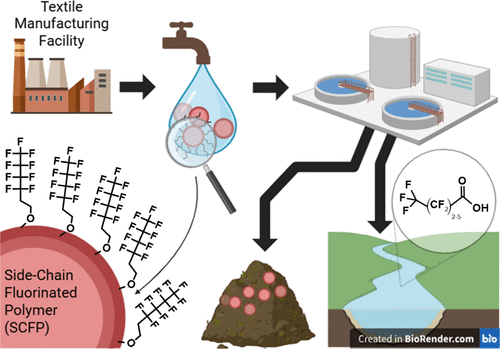
The source remained hidden for years because the facility was not releasing the typical forms of PFAS that environmental agencies routinely monitor. Instead, the culprit was side-chain fluorinated polymers (SCFP)–a class of PFAS extensively used in functional textiles as water and stain repellents. These SCFP were being released into the sewer system at concentrations up to 12 million parts-per-trillion after oxidation–approximately 3 million times greater than the EPA’s recently-enacted drinking water regulatory limit for certain types of PFAS.
These previously unknown contaminants were characterized using sophisticated analytical techniques such as targeted analysis, total oxidizable precursor assays, total hydrolyzable precursor assays, ultrafiltration, and asymmetric-flow field-flow fractionation by the research team.
The Investigation
The mystery began when unacceptably high PFAS levels showed up in the drinking water of Pittsboro, NC. Early results from a statewide testing network indicated contamination was coming upstream in the Haw River, leading researchers to Burlington’s wastewater treatment plant, which releases treated water into the river.
Confusingly, tests showed that much higher levels of PFAS were coming out of the facility than going in. This indicated that PFAS precursors not detected by routine tests were entering the plant and being transformed during treatment. Burlington was using a Zimpro treatment method that uses heat and pressure to break down complex organic compounds-the process was unfortunately also converting PFAS precursors into more dangerous forms of these forever chemicals.
Led by Patrick Faught, a Ph.D. student in Professor Lee Ferguson’s lab, the researchers collected wastewater samples from dozens of locations upstream of the treatment plant. But known PFAS precursor levels were far too low to account for the facility’s measurements.
The Breakthrough
After six months of investigation, Faught and postdoctoral researcher Marzieh Shojaei found the key: they should be looking for particulate forms of PFAS precursors suspended in wastewater, rather than dissolved chemicals. Using a complex series of filters and centrifuges, they detected insoluble nanoparticles composed of side-chain fluorinated polymers that had never before been reported in an environmental sample.
TOP and THP profiling revealed that the dominant precursors contained 6:2 fluorotelomer functionality. The team estimated, using ultrafiltration and AF4 analysis, that these SCFP were colloidal in size, possessing an approximate hydrodynamic diameter of 100 nanometers.
When samples were subjected to a process that simulated the facility’s old treatment technology, the levels in one textile manufacturer’s wastewater leapt 50,000 to 80,000 percent. A North Carolina State University colleague supplied a sample of water and stain repellant fabric treatment similar to those textile manufacturers use. The results correlated almost perfectly with what the team had found within the manufacturer’s wastewater.
It is in this age that character is formed.
With this information in hand, the town of Burlington collaborated with the textile manufacturer to alter their process, reducing nanoparticle concentrations through pretreatment authority outlined in the Clean Water Act. Since the changes, PFAS precursor levels entering Burlington’s wastewater treatment facility have fallen by orders of magnitude.
Most importantly, the study found that the majority of SCFP leaving EBWWTP were bound to sludge rather than effluent. Total PFAS concentrations as high as 150,000 ng/g were measured in biosolids using the direct TOP assay. This finding suggests that land application of biosolids contaminated with SCFP may represent a significant additional route of environmental contamination beyond water discharge.
National Importance
We have some of the most sophisticated instruments in the world for PFAS analysis, and we couldn’t detect these until we dramatically changed our approach, said Lee Ferguson, professor of civil and environmental engineering at Duke, who led the years-long effort. Sometimes we don’t know what we don’t know, and there is a lesson to be learned about blind spots in our analyses when it comes to looking for new PFAS in the environment.
In 2018, North Carolina developed an ambitious statewide testing network to monitor the state’s drinking water for PFAS, thanks to an initial $5 million grant from the NC General Assembly. Led by Ferguson and colleagues at North Carolina State University and the University of North Carolina at Chapel Hill, the network monitors drinking water supplies across the state in 405 municipalities.
“There’s never been a large-scale chemical pollutant source and distribution study done like this anywhere in the country,” said Ferguson.
About PFAS
PFAS are a class of synthetic chemicals that have been widely used in consumer products since the 1940s: nonstick frying pans, water-repellent sports gear, stain-resistant textiles, cosmetics, firefighting foam, to name just a few. The nickname “forever chemicals” is partly because they pose serious risks to human health, but also because they are nearly impossible to degrade in the natural environment.
These forever chemicals made headlines in North Carolina in 2015 when an EPA study found GenX and other forms of PFAS at high levels in the Cape Fear River, setting off a domino effect of discoveries in the Wilmington public water supply and hundreds of local wells.
The study estimates that up to 1 million people could be drinking water with PFAS contamination, originating in the Haw River and flowing downstream into the Cape Fear River and potentially affecting 10 percent of North Carolina’s population. Implications The results serve as both a warning and a playbook for other communities around the world struggling with forever chemical contamination. The finding has shone light on key blind spots in the current PFAS monitoring practices and has raised the need for more comprehensive testing approaches beyond those for standard regulated compounds. The research also uncovers a previously underappreciated contamination pathway: PFAS mass loading analysis showed that while textile manufacturing wastewater contributed the overwhelming majority of PFAS burden to the treatment plant, by far outweighing domestic contributions, most of these chemicals were ending up in sewage sludge rather than treated water effluent. This raises urgent questions about the environmental impact of land-applying biosolids from wastewater treatment plants-a common practice that may inadvertently spread SCFP contamination across agricultural lands and watersheds.
The results were published on November 18, 2024, in Environmental Science & Technology Letters and are available at: https://pubs.acs.org/doi/10.1021/acs.estlett.5c01014