Sydney, Australia – A six-month rooftop experiment has delivered the first real-world evidence that water-repellent jackets, uniforms and camping gear are continuously shedding per- and polyfluoroalkyl substances (PFAS) – the ultra-persistent compounds dubbed “forever chemicals” – into air, rain and soil.
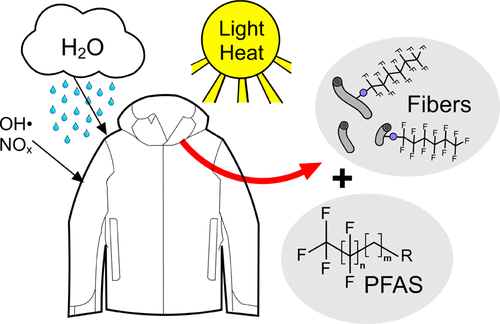
The study, led by Stockholm University and published in the American Chemical Society journal Environmental Science & Technology (DOI: 10.1021/acs.est.1c06812), found that everyday weathering by sunlight, heat, wind and precipitation broke down the fluorinated coatings on polyamide fabrics, releasing measurable quantities of regulated perfluoroalkyl acids (PFAAs) and microscopic fibres laden with side-chain fluorinated polymers (SFPs).
“Laboratories can’t replicate the full cocktail of urban pollutants, UV intensity and temperature swings that textiles face on a roof in Sydney,” says co-author Ian Cousins. “We wanted to see what actually happens when consumers wear and wash these garments for months.”
From Coating to Contamination
The team impregnated rip-stop polyamide with three commercial durable-water-repellent (DWR) finishes based on C4, C6 or C8 fluorinated side chains. Duplicate swatches were pinned 2.5 cm above a corrugated roof from August 2017 to February 2018, receiving 279 mm of rain and an average solar irradiance of 644 MJ m⁻². After three and six months, samples were abraded 3,000 Martindale cycles and laundered once at 40 °C to mimic normal use.
Results were striking:
- Total fluorine in the fabric dropped by up to 71 % for the short-chain C4 formulation and 47 % for the longer C8 version, signalling massive loss of the polymeric finish.
- Target PFAAs rose 20-fold above EU textile limits; PFOA in the C8 fabric climbed from 12 ng g⁻¹ to 713 ng g⁻¹, while PFHxA in the C6 fabric reached 865 ng g⁻¹, far higher than the proposed 25 ppb cap.
- Micro-fibres flaked off in visible clumps; SEM images showed cracked coatings, rounded warp edges and deep fissures after only half a year.
- Colour and function faded in step with chemistry: spray-ratings for water repellency fell from 5 (excellent) to 1 (wetting of entire surface) and black fabrics turned grey as surface fibres were lost.
Rain Washed Chemicals Away – But Not All
Spiked controls verified that 74–92 % of pre-added PFAAs disappeared from fabric within six months, proving rain efficiently strips soluble species. Yet the in-situ formation of new PFAAs more than compensated for wash-out, implying that residual manufacturing impurities – and perhaps the polymer itself – continually replenish the pollutant pool.
Oxidative “TOP” assays revealed a reservoir of extractable precursors in un-aged cloth equal to 60–7,300 times the native PFAA load. Only 29 % of those precursors were identifiable fluorotelomer alcohols (FTOHs); the rest remain unknown. “Even if companies switch to shorter-chain chemistry, the invisible impurities can still break down into regulated acids,” warns lead author Steffen Schellenberger.
Micro-Plastics Become Macro-Problem
Because the SFP film coats only the outer few nanometres of each fibre, any surface breakage releases particles highly enriched in fluorine. Combustion-ion chromatography showed that fibre loss accounts for the bulk of the missing mass balance – a delivery mechanism overlooked by previous indoor weathering studies. “Once these fibres reach rivers or soils they will keep degrading for decades, slowly leaking more PFAAs,” notes co-author Jonathan Benskin.
Regulatory Ripples
The findings arrive as the European Chemicals Agency finalises a sweeping PFAS restriction that could set 25 ppb limits for PFOA, PFHxA and PFOS in consumer textiles. Results suggest garments presently compliant on the shop shelf may exceed thresholds after a single season outdoors. “Ageing has to be built into compliance testing,” argues Cousins. “A passport that says ‘safe when new’ isn’t enough.”
Industry is already feeling pressure. “We’ve phased out C8, moved to C6, and now C4 is under scrutiny,” says a sustainability manager at a major European outdoor brand who was not involved in the study. “The paper confirms we need to accelerate non-fluorinated alternatives, not just shorter chains.”
Toward “Essential Use” Only
Authors stop short of calling for an immediate ban, but endorse last year’s UNEP recommendation that PFAS be limited to “essential uses” where performance is critical for health or safety – fire-fighter turnout gear, medical gowns, hazardous-material suits – and where alternatives do not yet exist. For rain jackets and backpacks, they say, existing hydrocarbon or silicone DWRs already meet most consumer needs.
The team acknowledges limitations: wash frequency, detergent chemistry and mechanical stress in real wardrobes differ from their single-launder protocol, while Sydney’s subtropical sunshine represents a worst-case scenario. Still, Schellenberger believes the direction is clear: “Every month we keep selling millions of these garments we’re expanding the global reservoir of PFAS. Substitution is the only emissions-free option.”
Next Steps
Researchers plan to repeat the exposure in temperate Sweden and quantify air- and rainwater-borne releases directly. Meantime, they advise consumers to choose PFAS-free labels, wash garments only when necessary, and demand brands disclose fluorine content – before the weather does it for them.
Source
An Outdoor Aging Study to Investigate the Release of Per- And Polyfluoroalkyl Substances (PFAS) from Functional TextilesSteffen Schellenberger, Ioannis Liagkouridis, Raed Awad, Stuart Khan, Merle Plassmann, Gregory Peters, Jonathan P. Benskin, and Ian T. CousinsEnvironmental Science & Technology 2022 56 (6), 3471-3479DOI: 10.1021/acs.est.1c06812