Landmark study shows PFAS pollutants double in concentration with each trophic level; industrial substitute F-53B poses particularly high risk
A groundbreaking study published in Nature Communications has provided the first systematic global-scale evidence of how per- and polyfluoroalkyl substances (PFAS) accumulate alarmingly through food webs. The international research team’s meta-analysis, integrating data from 119 food webs across 64 studies and covering 72 PFAS compounds, offers the most comprehensive scientific evidence to date on the ecological risks posed by these “forever chemicals.”
Trophic Magnification: A Doubling Threat at Each Level
The study’s core finding is alarming: PFAS exhibits significant trophic magnification, with an average trophic magnification factor (TMF) of 2.00. This means that with each step up the food chain—from plankton to small fish to large predators—PFAS concentrations double. This exponential accumulation places top predators, including humans, at risk of exposure levels far exceeding environmental background concentrations.
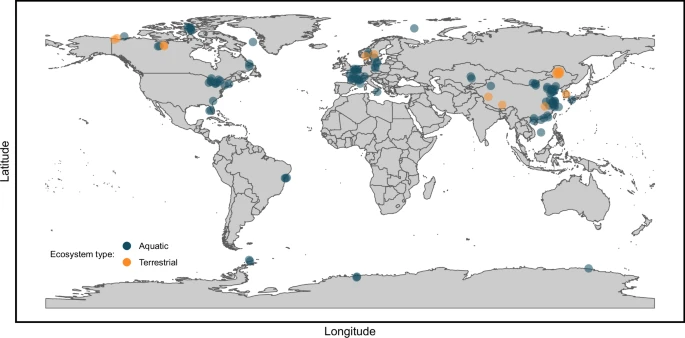
The analysis encompassed aquatic and terrestrial food webs globally, with 85% being aquatic systems, geographically concentrated in the Northern Hemisphere across East Asia, Europe, and North America. The research team extracted data from 1,009 trophic magnification factors, tracking how PFAS transfers from prey to predator and continuously bioaccumulates in organisms.
F-53B: An Overlooked High-Risk Alternative
Among all compounds studied, the industrial substitute F-53B (a chlorinated polyfluorinated ether sulfonate) showed the highest biomagnification potential, with a TMF of 3.07, exceeding that of perfluorooctane sulfonate (PFOS, TMF 3.02), which it was designed to replace. This finding is particularly concerning because F-53B remains unregulated at the international level while its use continues to expand.
F-53B was originally synthesized in the 1970s, and its production increased significantly after 2000 following the phase-out of PFOS, primarily serving China’s electroplating industry as a mist suppressant. Although some manufacturers ceased production in 2020, environmental monitoring has detected the substance widely in Chinese wildlife and ecosystems, with traces found in South Korea, Greenland, the United States, and Europe.
Research shows F-53B has been extensively detected in Chinese populations’ blood and is associated with various health concerns. The research team notes that F-53B may meet the criteria for classification as a “very bioaccumulative” (vB) substance under the EU REACH regulation, highlighting the urgency of current regulatory gaps. Besides F-53B, traditional compounds including perfluorodecanoic acid (PFDA, TMF 2.80) and perfluoroundecanoic acid (PFUnDA, TMF 2.41) also demonstrated significant trophic magnification.
Methodological Variations Drive Observed Differences
Another critical finding is that much of the observed TMF variation stems from inconsistent research methods rather than genuine ecological differences. The analysis revealed that methodological choices are the most important predictors of TMF estimation variability, with the model explaining 85% of total data variance.
Specifically, sample type selection has enormous impact on results. When lower trophic level organisms are analyzed as whole bodies while higher trophic level organisms use tissue-specific samples (such as liver or muscle), measured TMF values are 50% higher than when whole-body analysis is used throughout. This occurs because certain organs preferentially accumulate PFAS, leading to overestimation of magnification effects.
Additionally, concentration determination methods create significant differences: TMF values averaged 44% lower when PFAS concentrations were normalized for lipid or protein content. Methodological decisions including nitrogen isotope trophic enrichment factor selection and strategies for handling non-detected values all produced quantifiable effects on final results.
The research team emphasizes that this methodology-driven variability obscures the true ecological drivers of PFAS biomagnification, weakening risk assessment accuracy and delaying targeted regulatory measures.
Calls for Standardization and Stricter Regulation
Based on the findings, the research team proposes three key recommendations: First, researchers should perform biomass conversions to translate tissue-specific concentrations to whole-body equivalents, or use multiple tissues to analyze large species, improving comparability across trophic levels. Second, future studies should report TMF values for both protein-normalized and non-normalized concentrations, since PFAS preferentially binds to proteins. Third, studies should assess result sensitivity to variations in trophic enrichment factor values.
The results establish PFAS as persistent trophic magnifiers and provide a scientific framework for prioritizing high-risk compounds and harmonizing biomagnification assessments. The team calls for stricter PFAS regulations, particularly targeting unregulated high-risk alternatives like F-53B, to curb cascading impacts on ecosystems and human health.
This meta-analysis establishes a new benchmark for PFAS research, laying groundwork to bridge the gap between ecological theory and actionable chemical regulation. As PFAS continues its global penetration from industrial zones to remote habitats, the study’s urgency is clear: an average 2-fold trophic magnification means PFAS concentrations double at each nutritional level, threatening not only top predators and human health but potentially destabilizing biodiversity and food web resilience. Addressing methodological inconsistencies and strengthening global regulation have become imperatives for protecting ecosystems and public health.
Source: Riccardi, L., Yang, Y., Pottier, P., Morrison, K., Williams, C., Pollo, P., Hesselson, D., Neely, G.G., Taylor, M.D., Nakagawa, S., & Lagisz, M. (2025). Revealing the extent and drivers of PFAS trophic magnification: a meta-analysis. Nature Communications, 16, Article 10720. https://doi.org/10.1038/s41467-025-10720-x